A car dashboard with a digital instrument cluster and a central infotainment screen

    Automotive

    The head unit has no DOM. It still has to ship on a date.

    Cockpit software is validated on a bench, documented for the dealer network, and supported for a decade. One agent covers all three, because all three are somebody looking at a screen.

    Proof

    Tier 1 automotive supplier

    4,000 tests every night.

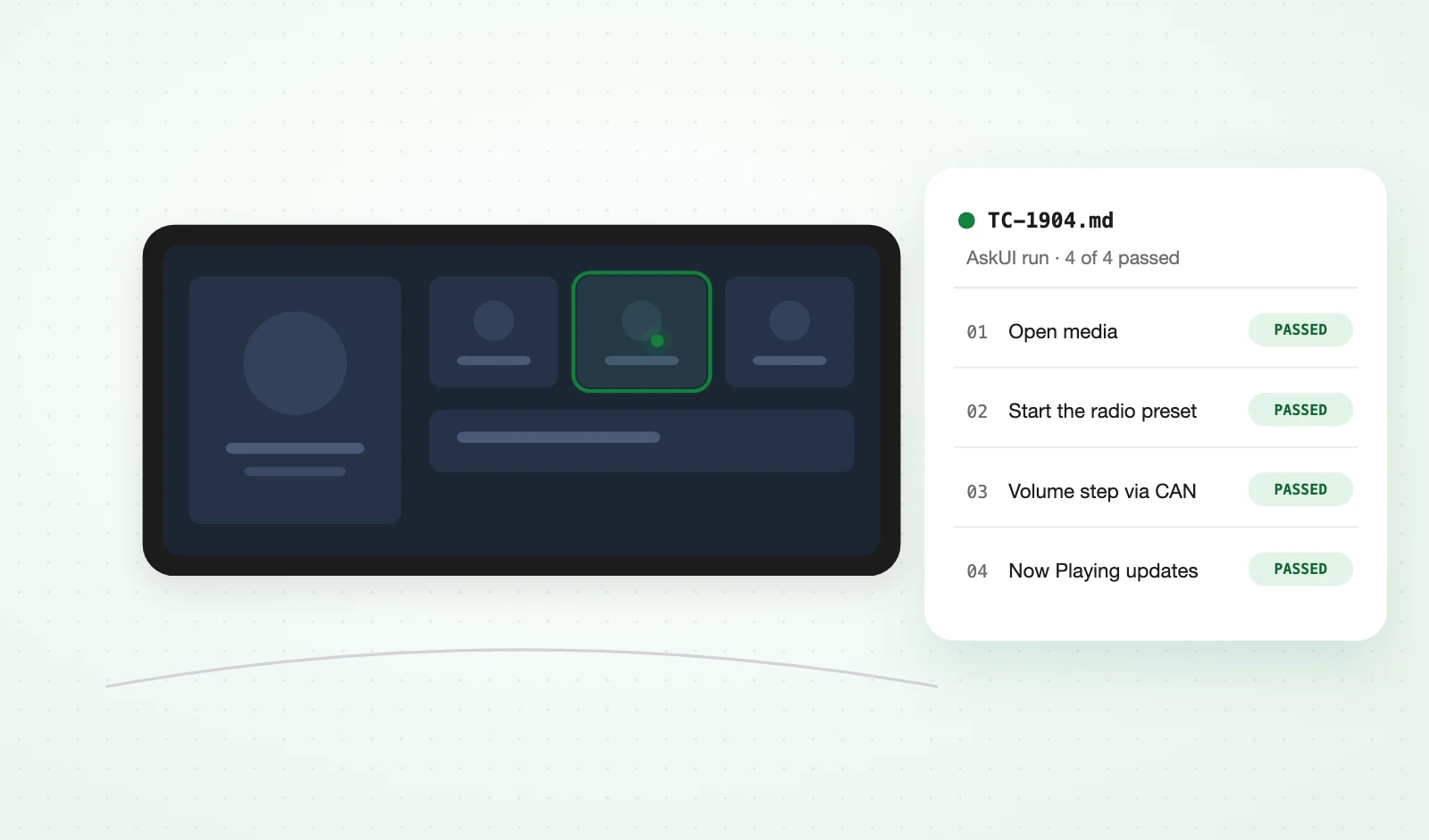
    A Tier 1 automotive supplier runs its infotainment and audio regression nightly in CI/CD, with daily reports and CAN signals checked on the head unit.

    Read the case study

    Why is this so hard to automate?

    The problem

    The only contract you are given is the screen itself, which is why regression still runs as people on a bench, and why the bench is the constraint on your release cadence.

    So what does one agent change?

    How it works

    Agentic test automation
    for every release.

    Regression on the real system, evidence for every step, and the scale to run it all, every day.

    V&V and QA teams

    Regression.

    Regression on the real head unit and on the HIL rack, triggered from CI, with a step report per run.

    Quality and compliance

    Evidence.

    Every run leaves a verdict, a screenshot and the agent's reasoning for each step, ready for review and audit.

    Test management

    Scale.

    Thousands of tests a day across variants, devices and releases, in CI, without a script to maintain.

    And the tools around the screen?

    Integrations

    One test plan. Every tool on the bench.

    AskUI drives the head unit and the tools around it, in one sequence, and writes one verdict report.

    1. Set ignition to ON with the canoe_set_signal tool
    2. Open Radio from the home screen
    3. Long-press the tile “FM 98.4”. Expected: “Saved to preset 2”
    4. Check with cantools_read that preset 2 carries 98.4 MHz on the bus
    5. Load the dSPACE scenario highway_60kmh, then open Nav
    • Vector CANoeSet and check bus signals, run simulations
    • dSPACELoad HIL scenarios and plant models
    • CanToolsDecode and verify CAN messages
    • CI and test managementGitLab, GitHub Actions, Azure DevOps
    • Any API or scriptHTTP, SQL, shell, MCP servers

    Each tool is wired in once, as a custom C# tool, a shell script, an HTTP call or an MCP server. The test plan sequences them with the screen steps, and every step lands in the same report.

    Automotive specs

    What it drives
    • Infotainment head units and centre stacks
    • Digital instrument clusters
    • HIL and SIL benches
    • Android Automotive and QNX targets
    • Rear-seat entertainment and passenger displays
    Enterprise apps
    ServiceNow, SAP, Siemens Teamcenter, Citrix and VDI: regression before every upgrade, and the same tests on a schedule in production.
    What the sector requires
    • Evidence that survives an audit: every step timestamped and screenshotted
    • On-premise and air-gapped deployment, because the bench is not on the internet
    • ISO 27001 certified, GDPR compliant, hosted in Germany
    At a glance
    No DOM required · Real bench or HIL rack · QNX, Android Automotive, Linux
    Integrations
    Vector CANoe · dSPACE · CanTools · CI and test management · Any API or script. Each tool is wired in once, as a custom C# tool, a shell script, an HTTP call or an MCP server. The test plan sequences them with the screen steps, and every step lands in the same report.

    See it on your own automotive systems.
    Send us ten test cases.

    Or download AskUI Desktop. No sign-up.