

Testing Infrastructure Series, Part 4
Executive Summary
ISTQB catalogs seven categories of test tools and warns that simply acquiring tools doesn't guarantee success. Most organizations end up managing a stack of tools that were never designed to work together. The integration tax compounds every quarter. Meanwhile, the management layer that ISTQB defines for planning, estimation, risk, monitoring, and defect tracking consumes more effort than the test execution itself. This post covers where management overhead lives, why tool sprawl makes it worse, and why the industry is shifting from buying tools to building on testing infrastructure.
The Management Layer Nobody Budgets For
ISTQB defines the activities that hold testing together. Test planning documents objectives, resources, and schedules. Entry criteria define what must be true before testing starts: environment ready, test data available, smoke tests passed. Exit criteria define what must be achieved before testing stops: coverage targets met, defects within agreed limits, regression tests automated. In agile, these are called Definition of Ready and Definition of Done.
Risk-based testing prioritizes effort based on likelihood and impact. Four response strategies exist: mitigation through testing, acceptance when no action is possible, transfer to a better-equipped team, and contingency through preventive measures.
ISTQB defines metrics across five dimensions: test progress, defect rates, risk exposure, coverage levels, and cost. Progress reports track ongoing work at regular intervals. Completion reports summarize entire milestones with quality evaluation, deviations, and lessons learned.
Every defect report needs a unique identifier, reproduction steps, environment details, expected versus actual results, severity, priority, and status tracking through the lifecycle from new to open to resolved to closed.
In theory, these activities ensure testing delivers value. In practice, writing reports, collecting metrics, reconciling data across tools, and formatting for stakeholders consumes a disproportionate share of management effort. Test plans get written once and never updated. Risk prioritization happens at the start and gets forgotten. Entry and exit criteria exist in a document nobody checks.
An agent that automatically verifies entry criteria before each test run, tracks execution metrics during testing, generates progress reports at regular intervals, performs impact analysis when code changes, writes structured defect reports with severity classification, and compiles completion reports at milestones does not replace the test manager's judgment. It replaces the data collection, tracking, and reporting that consume the manager's time. The management activities ISTQB defines for monitoring, control, and reporting are the Verify and Recover steps of the agentic loop applied at the project level.
Tool Sprawl: When Seven Tools Create Seven Problems
ISTQB defines seven tool categories. Management tools handle test cases, execution tracking, and defect management. Static testing tools support reviews and code analysis. Design and implementation tools generate test cases and test data. Execution and coverage tools run automated tests and measure metrics. Non-functional testing tools handle specialized testing like simulating thousands of concurrent users. DevOps tools support the CI/CD pipeline. Collaboration and deployment tools cover communication and infrastructure.
The syllabus is direct about tool risks. Teams assume complex tools are as simple as installing them. The time and cost for tool introduction, script maintenance, and process changes are consistently underestimated. Using automation when manual testing is more appropriate wastes resources. Tools only perform what they're instructed to do. Vendor dependency creates structural risk when vendors go out of business, retire products, or provide poor support. Open-source alternatives risk abandonment. Compatibility with the existing technology stack is critical but often untested before adoption. In regulated industries like automotive, medical devices, and aerospace, non-compliant tools create legal exposure.
These risks aren't theoretical. Every testing team with more than a few years of history has experienced multiple tool failures, forced migrations, and integration projects that cost more than the tools themselves.
The root cause is that each tool was built to solve one problem. The management tool doesn't talk to the automation tool. The automation tool doesn't share data with the performance tool. The defect tracker lives in a different system than the test execution logs. Integration becomes a project in itself, and the integration cost eventually exceeds the value each individual tool provides.
"Why Raw LLM APIs Don't Scale to Production Testing"
Teams exploring agentic testing often start with raw LLM APIs. The initial demo is impressive. The production experience is not.
Raw LLM APIs see only screenshots, one per turn, with no DOM, no selectors, and no accessibility tree. They're non-deterministic: every run calls the model again and produces slightly different results. There's no governance.
The agent does whatever the LLM decides with no guardrails, no audit trail, and no PII detection. Desktop and mobile environments are unsolved. Most computer use APIs target browsers, but SAP, Citrix, ERP, and HMI environments aren't supported. Costs explode with volume because full LLM inference runs on every single execution. And screenshots are sent to cloud providers with no on-premise option and no model choice.
These are the six walls every team hits after the first demo. They're the reason moving from prototype to production with raw APIs fails.
An infrastructure layer solves each one. OS-level perception combines screen understanding with selectors for accuracy that screenshots alone can't provide. Deterministic caching replays actions from cache after the first execution, making subsequent runs near-zero cost and fully repeatable. A policy engine with PII detection and visual audit trail provides governance that regulated industries require. Native OS controllers for keyboard, mouse, multi-screen, and touch work across web, desktop, mobile, terminals, Citrix, VDI, and HMI. On-premise and air-gapped deployment keeps data within the network. And bring-your-own-model architecture means the infrastructure works with Claude, GPT, Gemini, or open-source models without lock-in to any single provider.
From Tools to Infrastructure: The Shift
The tool-by-tool approach made sense when testing was a distinct phase. A management tool for planning. An automation tool for execution. A reporting tool for completion. Each phase had clear boundaries and the tools mapped to them.
That model breaks when testing is continuous. In DevOps, every commit triggers testing. In agile, test levels overlap. In enterprise environments, the test target spans physical devices, virtualized desktops, and cloud instances simultaneously.
What teams need isn't another tool. It's infrastructure that provides four capabilities.
A unified perception layer. One way to observe what's on the screen regardless of whether it's a web browser, desktop application, Canvas element, Citrix session, or physical HMI. Not seven tools with seven different selector strategies. This is the Observe step of the agentic loop.
A unified execution layer. One way to interact with the system through OS-level input for keyboard, mouse, and touch, regardless of platform. Not separate frameworks for web, desktop, and mobile. This is the Act step.
Built-in governance. Policy enforcement, visual audit trails, PII detection, and deterministic caching as part of the infrastructure. Not add-on tools that need separate integration. This is the Verify step.
Model independence. The ability to use any AI reasoning model as the thinking layer while the infrastructure handles perception and execution. The reasoning layer is interchangeable. The infrastructure layer is consistent across every platform. This is what bring-your-own-model means in practice. This is the Reason step.
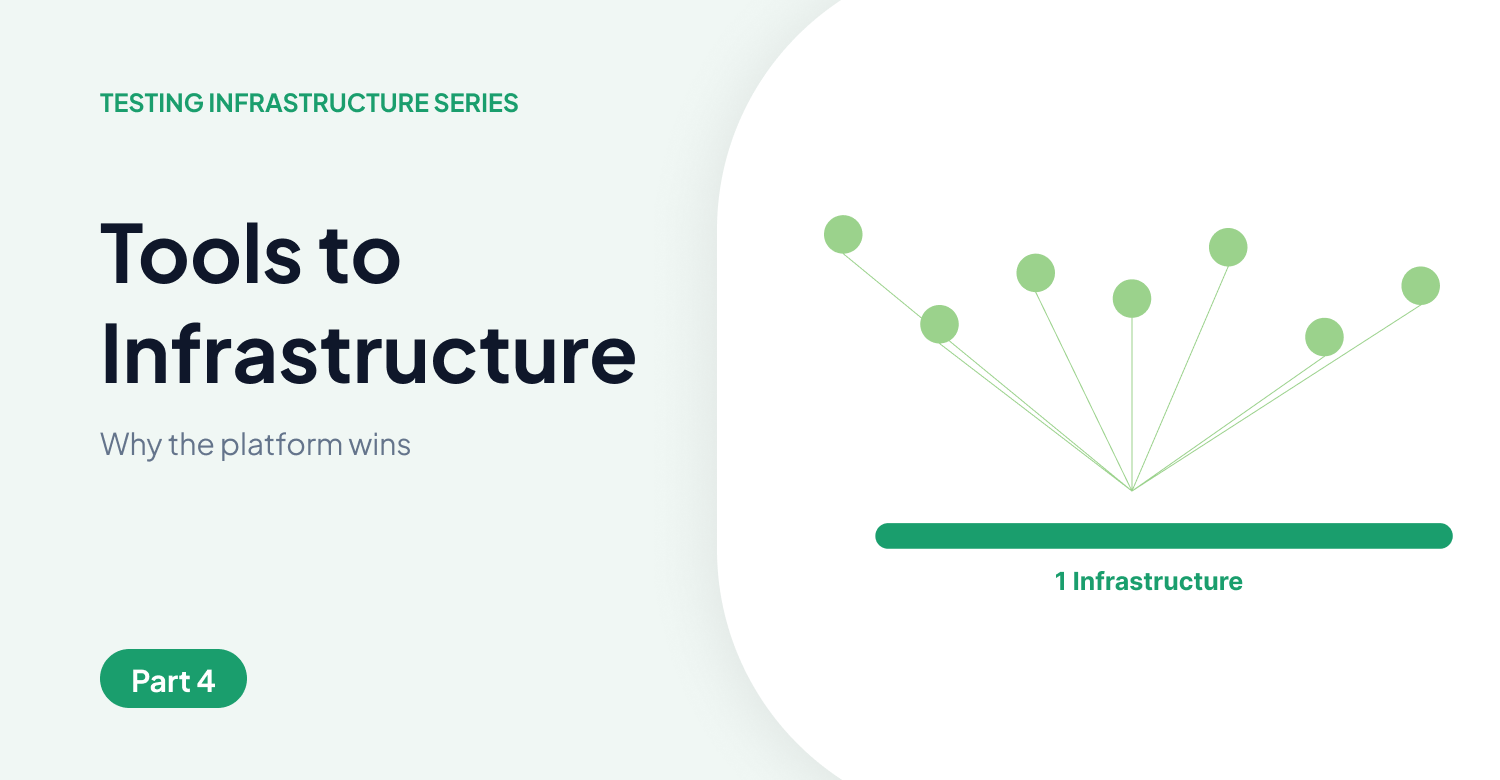
The tools ISTQB describes for management, execution, static analysis, and DevOps become capabilities provided by the platform rather than separate products that need integration.
This is what AskUI provides: infrastructure for computer-use agents on any device.
What This Series Has Covered
This series started with a question: why does CI pass while the UI is broken?
Post 1 showed that QA and QC are structurally confused, that shift-left fails for hardware, and that QA teams have become Lab SREs managing infrastructure instead of testing products.
Post 2 showed that V-Model test levels collapse when the test object has no DOM, when environments can't be provisioned, and when regression suites compound until they consume the QA budget.
Post 3 showed that scripted coverage has a ceiling, that exploratory testing stays bottlenecked by human availability, and that agents can perform the same ISTQB-defined test activities at machine scale.
This post showed that adding more tools makes integration worse, that test management overhead is the hidden cost nobody budgets for, and that the industry is shifting from tools to infrastructure.
The ISTQB framework defines what testing should look like. Computer-use agents, running on infrastructure that provides OS-level perception, execution, and governance across any device, make that framework work in environments where traditional automation can't.
For teams ready to move beyond the demo, the next step is a proof of concept on your actual environment, not a generic setup, but your stack, your devices, your edge cases.
FAQ
What are entry and exit criteria in test planning?
Entry criteria are preconditions before testing starts, such as environment readiness, test data availability, and smoke test passage. Exit criteria define what must be achieved to declare testing complete, such as coverage targets met, defects within agreed limits, and regression tests automated. In agile these are called Definition of Ready and Definition of Done.
What are the main risks of test tools according to ISTQB?
Unrealistic expectations about tool complexity, underestimated costs for introduction and maintenance, inappropriate automation of tasks better suited for manual testing, over-reliance on tools, vendor dependency, open-source abandonment, compatibility issues, and non-compliance with regulatory standards.
What is the difference between test tools and testing infrastructure?
Test tools are individual applications serving specific functions. Testing infrastructure is a unified platform providing perception, execution, and governance across all platforms and environments. Infrastructure replaces tool integration with built-in capabilities.
What are the six limitations of raw LLM APIs for testing?
Screenshot-only perception with no DOM or selectors, non-deterministic execution, no governance or audit trail, no desktop or mobile support beyond browsers, full inference cost on every run, and data leaving the network with no on-premise option.