 YouYoung Seo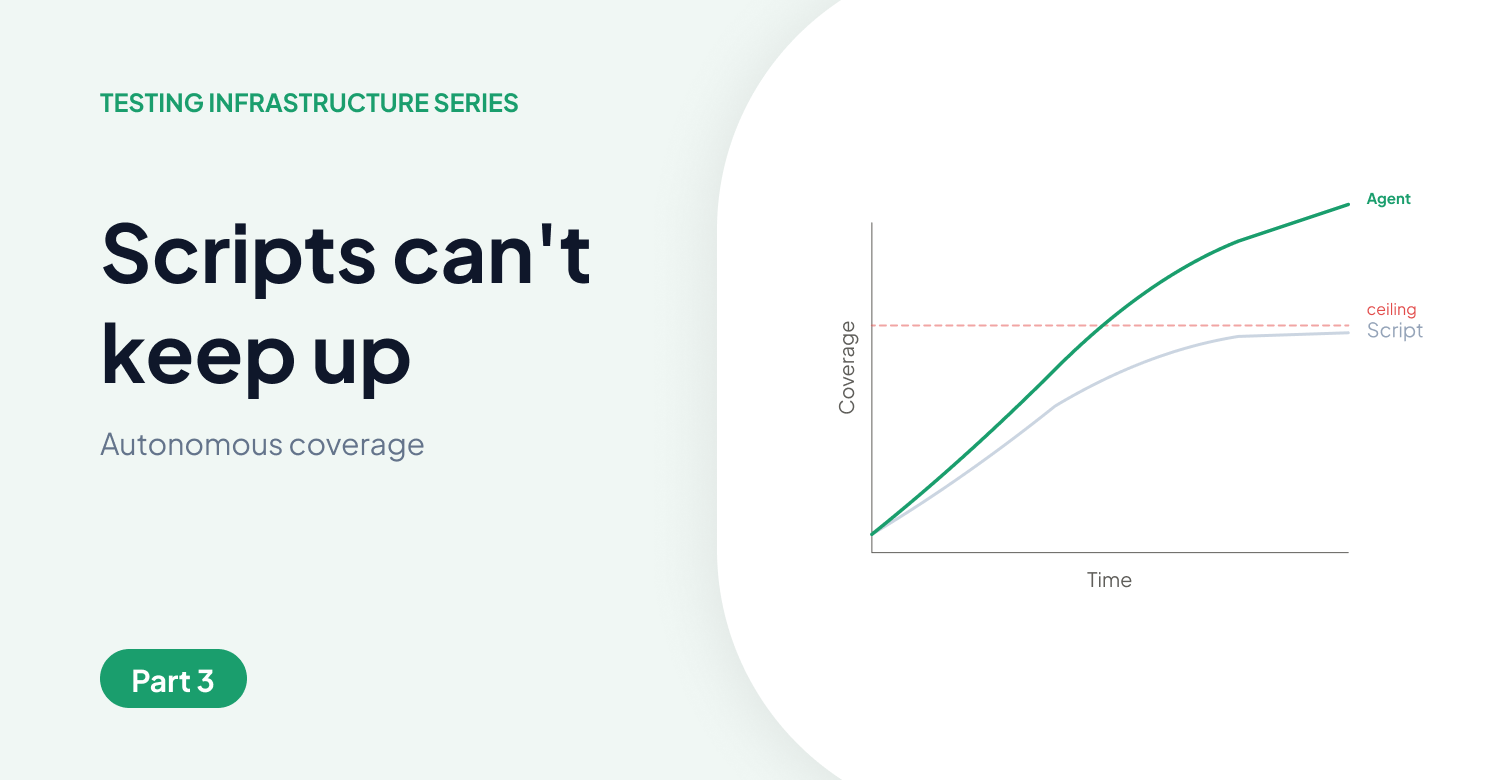
Testing Infrastructure Series, Part 3
Executive Summary
ISTQB Principle 2 says exhaustive testing is impossible. Test techniques exist to reduce test cases while maintaining coverage. Black-box techniques work from specifications. White-box techniques work from code. Experience-based techniques work from human intuition. All three assume a human is designing the test. That assumption creates a coverage ceiling that scripted automation can't break through. This post covers where each technique category reaches its limit and how goal-driven agents extend coverage into territory scripts can't reach.
Scripted Coverage Has a Ceiling
Black-box techniques like equivalence partitioning, boundary value analysis, decision table testing, and state transition testing are powerful when detailed requirements exist. Equivalence partitioning divides inputs into ranges where all values behave identically and tests one value per range. Boundary value analysis tests at the edges where developers most commonly make errors. Decision tables handle logical conditions with binary inputs. State transition testing covers systems where actions move the application between states, like an ATM rejecting a card after three wrong PIN attempts.
These techniques work well for deriving structured test cases from clear requirements. They fail when requirements are vague, incomplete, or constantly changing, which is the norm in agile development and especially in hardware-dependent environments where specifications evolve alongside the physical prototype.
White-box techniques provide objective metrics. Statement coverage measures the percentage of code statements executed. Branch coverage measures decision branches executed and is strictly stronger: achieving 100% branch coverage guarantees 100% statement coverage, but not the reverse. White-box testing detects defects even when specifications are weak.
But white-box has a fundamental blind spot. If the software doesn't implement a requirement, white-box testing can't detect the omission. You can't test code that doesn't exist. And for hardware-dependent systems, code coverage says nothing about whether the physical device behaves correctly. 100% branch coverage on the HMI control software doesn't tell you whether the indicator light actually blinks.
The best practice ISTQB recommends is combining both: black-box for the behavioral perspective, white-box for the structural perspective. Together they cover more than either alone. But both are still limited to scenarios someone anticipated and wrote a test for. The paths nobody thought to explore remain untested.
Three ISTQB principles converge on this problem. Principle 2 says exhaustive testing is impossible, which means every test suite is incomplete. Principle 5 says tests wear out, which means even the tests you have become less effective as the product evolves. Principle 4 says defects cluster, which means the defects you haven't found are concentrated in the areas you haven't tested.
Exploratory Testing: ISTQB's Answer and Its Bandwidth Constraint
ISTQB recognizes that formal techniques have limits and defines experience-based techniques to fill the gap.
Error guessing uses past experience to anticipate likely defects. It's the primary approach when specifications are poor, time is tight, or the team lacks formal training in test techniques. A systematic variant called fault attack targets specific defect types the tester suspects based on domain knowledge.
Exploratory testing is the most powerful and most misunderstood technique in the ISTQB framework. It is not randomly clicking through an application. It is simultaneously designing, executing, and evaluating tests while learning about the system under test. Sessions are time-boxed between 30 and 120 minutes. Each session follows a mandatory test charter that documents the scope, objectives, environment, observations, and findings. Debriefing sessions with stakeholders follow each session.
Checklist-based testing uses structured questionnaires with yes/no answers to verify standard features. It's efficient but requires ongoing maintenance because checklists become outdated as products evolve.
All three experience-based techniques depend on the tester's domain knowledge and past experience. A banking tester's intuition doesn't transfer to automotive. A junior tester can't effectively apply error guessing. And the biggest constraint is bandwidth. Exploratory testing happens "when we have time," which in most organizations means it almost never happens at the depth it should.
What the Agent Actually Does: ISTQB Activities at Machine Scale
This is where the connection between ISTQB's framework and computer-use agents becomes concrete.
The agent doesn't execute a fixed script. It receives a goal and determines the actions needed to achieve it. It observes the current screen state, reasons about the next step, acts through OS-level input, verifies the outcome, and recovers if something unexpected happens. This is the agentic loop from the series introduction applied to test execution.
The activities the agent performs map directly to what ISTQB defines as test activities.
Interpreting and executing Gherkin test cases. The agent receives Given-When-Then specifications as input and translates them into OS-level interactions with the actual system. "Given the vehicle is in park mode, When the driver selects the climate control panel, Then the temperature display should show the current cabin temperature within 2 seconds." The agent reads this specification, perceives the current screen, executes the described actions, and verifies the expected outcome. The Gherkin spec becomes the executable test without a separate script-writing step.
Performing exploratory testing with test charters. The agent operates within a defined scope, just like ISTQB prescribes. It explores the UI within that scope, observes behavior, documents anomalies, and reports findings. Sessions are time-boxed. The difference is that the agent can run these sessions 24 hours a day, 7 days a week, across multiple devices simultaneously.
Applying checklist-based testing. The agent systematically verifies features against a checklist, checking each item and flagging deviations. Unlike a static checklist maintained in a spreadsheet, the agent adapts to the current UI state. If a button moves or a label changes, the agent re-perceives and continues rather than failing with a stale reference.
Logging test results and identifying defects. Every action the agent takes is logged with screenshots, timestamps, and the observed versus expected outcome. When results deviate, the agent generates a structured defect report that includes a unique identifier, severity and priority classification, reproduction steps, environment details, and the expected versus actual result. This matches the defect report structure that ISTQB defines as the minimum standard for comprehensive defect documentation.
Each of these activities follows the same agentic loop. Observe, reason, act, verify, recover. The loop is identical whether the agent is executing a Gherkin specification, running an exploratory session, or checking items off a list. The technique changes. The execution pattern stays the same.
This isn't replacing testers. It's removing the bandwidth ceiling that has always limited how much exploratory and experience-based testing teams can afford. The techniques ISTQB describes are sound. The constraint was always execution capacity.
What This Changes for Test Strategy
If your coverage is plateauing, you've extracted the value that scripted techniques can provide. Adding more scripts gives diminishing returns. Goal-driven agents find what scripts miss by exploring paths nobody anticipated.
If your exploratory testing is limited to "when we have time", that means it's limited to almost never. Agents run exploratory sessions continuously, not just when a senior tester has a free afternoon.
If your checklists are outdated, the problem is maintenance. Nobody updates them. Agents that perceive the actual screen state don't depend on manually maintained references. They adapt to what's in front of them.
If your HMI test coverage stops at the UI layer, code coverage and UI checks alone can't verify physical behavior. Agents that observe across UI, log, and hardware levels extend coverage to where the real defects hide.
FAQ
What are the three categories of test techniques in ISTQB?
Black-box techniques are specification-based and derive tests from requirements. White-box techniques are structure-based and derive tests from code. Experience-based techniques rely on tester knowledge, domain expertise, and intuition. All three are complementary and should be used together for comprehensive coverage.
Why does 100% code coverage not guarantee quality?
Statement and branch coverage measure which code has been executed, not whether the code implements all requirements correctly. Code that was never written for a missing requirement gets 0% coverage by definition. For hardware systems, code coverage also says nothing about whether the physical device behaves as expected.
What is exploratory testing according to ISTQB?
Simultaneously designing, executing, and evaluating tests while learning about the system under test. It uses time-boxed sessions between 30 and 120 minutes with mandatory test charters. It requires analytical thinking, curiosity, and domain knowledge. It is not random clicking.
How do agents perform exploratory testing?
Agents receive a goal and a scope equivalent to a test charter. They observe the current UI state, take actions to explore the system, verify outcomes, and report anomalies. They follow the same structured framework ISTQB defines for human exploratory testing but run continuously without the human bandwidth constraint.