

Title: Why Every Test Level Breaks Before Production
Testing Infrastructure Series, Part 2
Executive Summary
The V-Model promises that every development phase has a corresponding test level. Requirements map to acceptance testing. Architecture maps to system testing. Code maps to unit testing. In practice, the model falls apart when the test object includes hardware, the environment can't be provisioned, or the team works in agile sprints where test levels overlap. This post covers where test levels break, why the cheapest testing gets skipped, and how regression suites grow until they consume the QA budget.
The V-Model: Clean Theory, Messy Reality
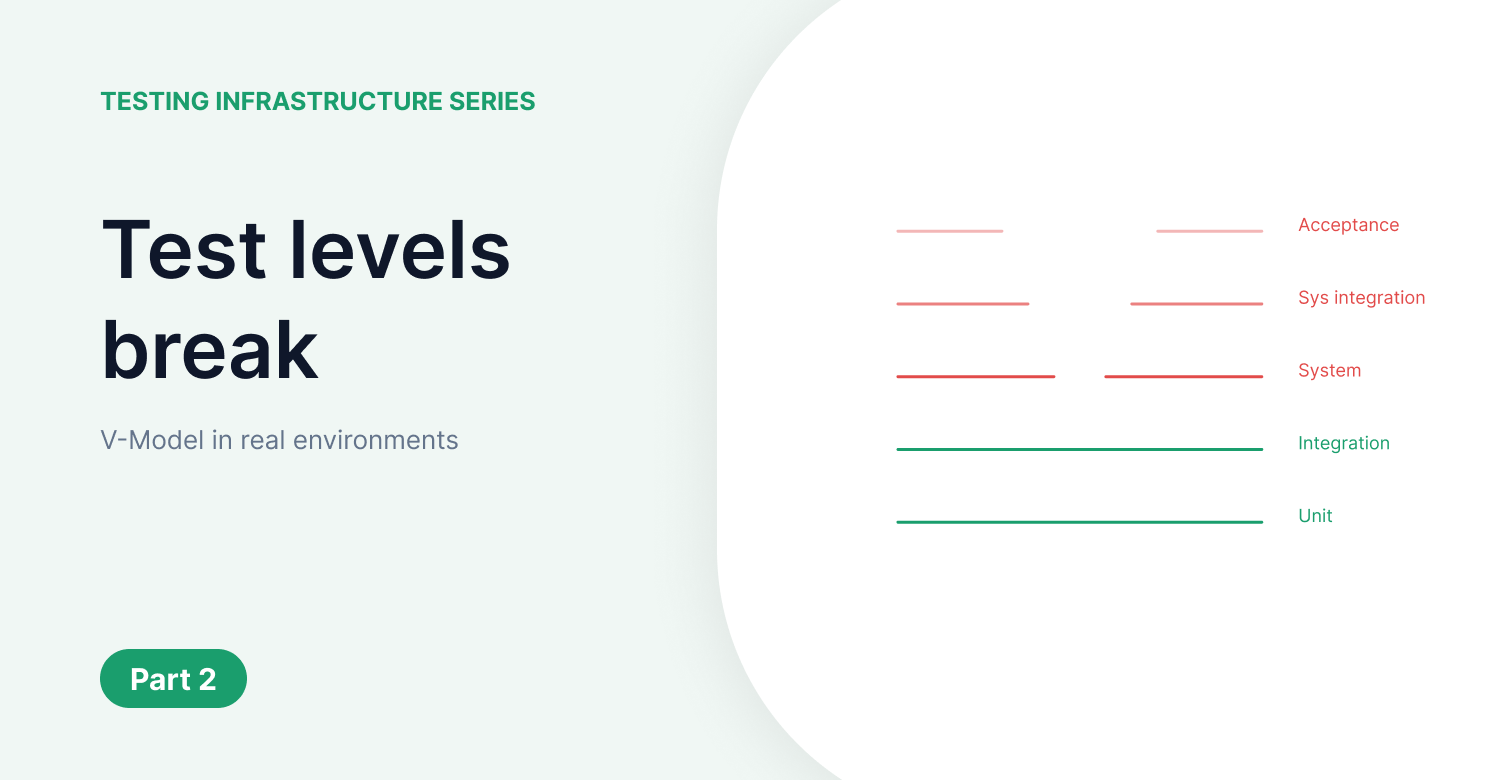
ISTQB defines five test levels. Component testing validates the smallest testable units in isolation. Component integration testing validates interactions between components within the same module. System testing validates the entire application as one unit. System integration testing validates interfaces between separate systems. Acceptance testing validates that the product meets business requirements.
In the V-Model, each level maps to a development phase. Exit criteria of one level become entry criteria for the next. This works when three conditions are met: the test object is accessible, the environment is controlled, and the boundaries between levels are clear.
For an automotive HMI team, all three conditions fail regularly.
The test object at the system level isn't just code. It's code running on a specific OS, connected to specific hardware, rendering on a specific display. When that display has no DOM, no accessibility tree, and no addressable UI elements, selector-based automation is blind. This is the reality for Canvas-rendered UIs, Citrix sessions, and embedded HMI displays.
The environment problem is equally concrete. ISTQB recommends representative test environments that simulate the target system. For SaaS, Docker handles this in seconds. For hardware-dependent systems, the "environment" includes physical devices that cost tens of thousands of euros and can't be replicated on demand.
The boundary problem shows up in agile. A single sprint might include unit, integration, and system testing for different features simultaneously. The sequential V-Model flow doesn't match how these teams actually work.
Computer-use agents address the test object problem directly. They perceive the rendered screen regardless of the underlying technology and interact through OS-level input. This means system testing and system integration testing work the same way whether the target is a web app, a desktop application, or an embedded HMI. Consider the vehicle indicator example from the series introduction. An agent can tap the indicator control on the HMI display, verify the blinking arrow appears on screen at the UI level, check the CAN Bus log for the correct signal at the log level, and confirm through a camera feed that the physical indicator light is active at the hardware level. That is V-Model system integration testing executed across all three validation layers.
Static Testing: The Cheapest Testing Nobody Does
ISTQB makes a clear distinction between static testing and dynamic testing. Static testing examines work products without executing code. You read a requirement document, spot an ambiguity, and report it. The defect never reaches the codebase. Dynamic testing runs the code and observes failures during execution.
Static testing catches defect types that dynamic testing cannot: inconsistencies and contradictions in requirements, unreachable code paths, interface mismatches between calling and called functions, traceability gaps where acceptance criteria have no corresponding test cases. The ISTQB syllabus identifies four review types ranging from informal buddy checks to formal inspections with entry and exit criteria, defined roles, and metrics collection.
The problem is that reviews require human attention, and there's never enough. Requirements reviews get skipped when deadlines tighten. Code reviews happen but focus on style rather than logic. Design reviews get scheduled and then canceled.
Agents can perform the volume work in static testing. They can review requirements for ambiguities, contradictions, inconsistencies, and omissions. They can perform static analysis of code for defects, standards compliance, and complexity. They can check acceptance criteria for testability before a sprint begins. The human reviewer then focuses on the anomalies the agent flags rather than reading every document line by line. The agent handles volume. The human handles judgment.
This is the QA/QC split from Post 1 applied to documentation. The agent performs QC on work products by finding defects. The human performs QA by deciding which standards to enforce and which findings matter.
The BDD Gap: When Specifications Can't Become Tests
ISTQB Foundation 4.0 covers three test-driven approaches. TDD works at the unit level, is technical-facing, and has developers writing tests before code. ATDD works at the acceptance level, is business-facing, and derives tests from acceptance criteria. BDD uses Given-When-Then format in Gherkin language to express desired behavior in natural language all stakeholders can understand.
All three implement shift-left by making tests the specification rather than a post-hoc verification.
The gap appears at execution time. A team writes a Gherkin specification: "Given the vehicle is in drive mode, When the driver activates the left indicator, Then the HMI displays a blinking left arrow within 200ms." The specification is clear, testable, and agreed upon by all stakeholders.
But no traditional automation framework can execute this against an embedded HMI display. Selenium needs a DOM. Appium needs an accessibility tree. The embedded display has neither.
Computer-use agents close this gap through intent-based execution. They receive the Given-When-Then specification and translate it into OS-level interactions with the actual system. The agent perceives the current screen state, executes the indicator activation, and verifies the blinking arrow appears within the specified timeframe. The specification becomes the test. No separate script-writing step, no brittle selectors, no framework-specific translation layer.
The Maintenance Trap: When Regression Eats the Budget
ISTQB distinguishes confirmation testing from regression testing. Confirmation testing reruns the specific test that revealed a defect to verify the fix works. Regression testing checks that previously passing functionality still works after changes.
Both apply at every test level and both are strong candidates for automation because they're repetitive. But here is where the economics break down.
Every change to a live application triggers regression testing. ISTQB identifies four triggers: modifications for minor changes, upgrades for new features, migrations for platform changes, and retirement for end-of-life products. Each trigger requires impact analysis to identify affected areas, followed by scoped regression testing.
Over time, regression suites grow with every release. They become the largest and most expensive part of the QA effort. Teams spend more time maintaining and running regression suites than designing new tests. This is the maintenance trap.
The trap is worse for hardware-dependent teams because regression tests that involve physical devices are slow and expensive to run. Each execution requires the physical environment to be provisioned, configured, and reset.
Two capabilities of an infrastructure layer address this directly. Self-healing means the agent adapts when the UI changes rather than failing with a broken selector. A button moves, a label changes, a menu reorganizes. Instead of a test failure and a manual script update, the agent re-perceives the screen and continues. Deterministic caching means the first execution calls the AI model for reasoning, but subsequent identical runs replay from cache at near-zero cost. Raw LLM APIs charge full inference on every run. Infrastructure with caching makes regression testing economically viable at scale.
FAQ
What is the V-Model in software testing?
A sequential SDLC model where each development phase has a corresponding test level. Requirements map to acceptance testing, system design to system testing, detailed design to integration testing, and coding to unit testing. Exit criteria of one level become entry criteria for the next.
What is the difference between static and dynamic testing?
Static testing examines work products without executing code, finding defects directly through reviews and analysis. Dynamic testing runs code and observes failures during execution. Both are necessary. Static testing catches requirement gaps and code issues that dynamic testing cannot detect.
What is the difference between confirmation testing and regression testing?
Confirmation testing reruns the specific test that revealed a defect to verify the fix. Regression testing checks that previously passing functionality still works after changes. Confirmation asks "is this defect fixed?" while regression asks "did the fix break anything else?"
How does intent-based execution close the BDD gap?
Agents receive Given-When-Then specifications and translate them into OS-level interactions with the actual system. They perceive the screen, execute the specified actions, and verify outcomes without requiring DOM access, selector frameworks, or separate script translation.