 YouYoung Seo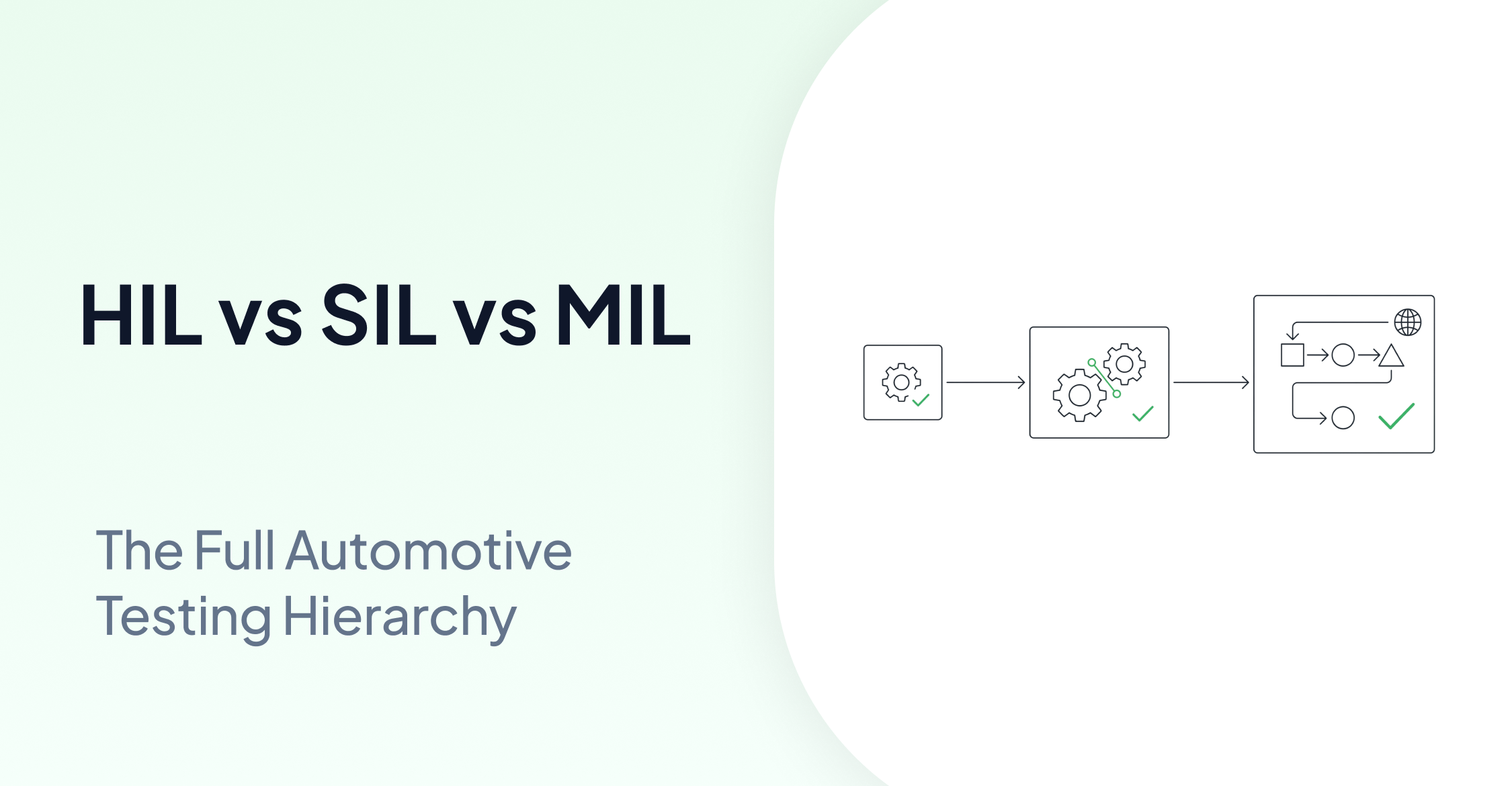
TLDR
MIL, SIL, and HIL are three distinct stages in the automotive V-Model testing hierarchy, each operating at a different level of hardware fidelity. Understanding the difference between HIL and SIL testing determines which defects you catch, how early you catch them, and what it costs to fix them. This post explains the technical boundary between each stage and where HMI validation fits.
Introduction
If you are responsible for validating embedded software in automotive, railway, or industrial systems, you already know that testing at the wrong level costs time and money. A bug caught in Model-in-the-Loop costs almost nothing to fix. The same bug found during a vehicle-level integration test can trigger a full re-spin of the software stack. The question is not whether to use MIL, SIL, or HIL. The question is which stage is the right gate for which class of defect.
MIL SIL HIL testing is not a single methodology. It is a progression of test environments, each with increasing hardware fidelity and decreasing speed of iteration. Each stage maps to a specific phase on the V-Model, and each carries a different cost profile for defect discovery. Misunderstanding where one stage ends and the next begins is one of the most common sources of late-stage integration failures in embedded software development.
This post walks through each stage technically, explains the boundary conditions that determine when you move from one to the next, and covers where HMI display validation sits in this hierarchy. If you work on digital cockpit or cluster software, that last part is where most of the practical complexity lives.
What MIL Testing Actually Tests
Model-in-the-Loop (MIL) testing executes the control algorithm model, typically built in MATLAB/Simulink or a similar model-based design environment, against a simulated plant model. No generated code is involved. The model runs in a simulation environment, and the test validates logical behavior: does the control logic produce the correct outputs for a given set of inputs?
MIL is the earliest practical test stage. Cycle times are fast because you are not compiling or deploying code. A developer can run thousands of test cases in the time it would take to set up a single HIL bench. The trade-off is fidelity. You are testing the algorithm, not the implementation.
Typical defects caught at MIL include logic errors in state machines, incorrect threshold values, missing transitions, and timing assumptions that do not hold under edge-case inputs. MIL cannot catch code generation artifacts, compiler-specific behavior, or any issue that originates in the runtime environment.
For teams following ISO 26262 or IEC 61508, MIL corresponds to software unit verification at the model level, before code generation. It is a required stage for safety-critical components developed under a model-based design workflow.
What SIL Testing Actually Tests
Software-in-the-Loop (SIL) testing replaces the model with generated or hand-written production code, compiled and executed on a host PC rather than on the target ECU hardware. The same simulated plant model used in MIL typically provides inputs and receives outputs. The difference is that you are now testing the actual software artifact that will ship, not the model it was generated from.
SIL exposes a class of defects that MIL cannot reach. Code generation errors, integer overflow and underflow conditions, type casting issues, and fixed-point arithmetic errors all become visible at this stage. If your tool chain generates code automatically, SIL is the first gate where you validate that the generated code matches the model's intended behavior.
Execution still happens on a development machine, so iteration is fast compared to HIL. You can run SIL tests in a CI pipeline without any specialized hardware. This makes SIL a practical regression stage for software teams working in continuous integration workflows. The gap between MIL and SIL is also where many automotive teams enforce code coverage metrics under ISO 26262 Part 6, specifically for structural coverage at the MC/DC level for ASIL C and D components.
The key limitation of SIL is that it runs on a different processor architecture than the target ECU. Timing behavior, memory layout, interrupt handling, and hardware peripheral interaction are all abstracted away. Any defect that depends on the target hardware environment will not appear in SIL.
What HIL Testing Actually Tests
Hardware-in-the-Loop (HIL) testing executes the production software on the actual target ECU hardware, connected to a real-time simulator that emulates the rest of the vehicle or system. Sensor signals, CAN messages, LIN bus traffic, and power supply behavior are all generated by the simulator. The ECU responds as if it were installed in a vehicle, without a physical vehicle being present.
The difference between HIL and SIL testing is fidelity to the target execution environment. HIL catches timing violations, interrupt latency issues, hardware driver defects, watchdog behavior, and any software behavior that depends on the specific memory map or peripheral configuration of the production ECU. These defects are invisible in SIL by definition.
HIL is also the first stage where you can test the full communication stack. A test can inject a CAN signal at the bus level and verify that the ECU responds correctly, both in terms of software behavior and in terms of what appears on connected displays. This is where Signal-to-UI Verification becomes a practical requirement. If a CAN signal is supposed to trigger a warning lamp in the digital cluster, HIL is the stage where you validate that end-to-end path under real timing conditions.
HIL benches are expensive to procure and maintain, and test execution is significantly slower than SIL. A regression suite that runs in minutes on a SIL host may take hours on a HIL bench. This makes efficient test prioritization critical. For a deeper look at how HIL testing applies specifically to infotainment and cluster validation, the AskUI post on HIL testing for automotive infotainment covers the hardware configuration and toolchain integration in detail.
Comparing the Three Stages
The following table summarizes the key technical boundaries between the three stages.
| Attribute | MIL | SIL | HIL |
|---|---|---|---|
| What executes | Algorithm model | Compiled production code | Production code on target ECU |
| Hardware present | None | None (host PC) | Target ECU + real-time simulator |
| Plant model | Simulated | Simulated | Simulated (real-time) |
| Defects caught | Logic, algorithm | Code gen, arithmetic, type errors | Timing, drivers, peripherals, bus |
| CAN bus interaction | None | None | Full bus-level signal injection |
| HMI display validation | Not applicable | Limited (no display hardware) | Full end-to-end possible |
| Iteration speed | Fastest | Fast | Slowest |
| CI/CD integration | Yes | Yes | Partial, with specialized setup |
| ISO 26262 phase | Software unit (model) | Software unit (code) | Software integration and system |
One important nuance: PIL (Processor-in-the-Loop) sits between SIL and HIL in some workflows. PIL runs the production code on the actual target processor but without the full ECU hardware context. It is useful for validating that the processor architecture does not introduce numerical differences versus the host machine, particularly for floating-point and fixed-point arithmetic. Not all teams use PIL, but it is a common addition in powertrain and chassis control development.
Where HMI Validation Fits in the Hierarchy
HMI display validation does not fit cleanly into any single stage of the MIL-SIL-HIL hierarchy. This is one of the persistent practical problems for teams developing digital cockpit and cluster software.
At the MIL and SIL stages, the display hardware is not present. You can validate the software logic that drives display outputs, but you cannot validate what actually appears on the screen. This means that rendering defects, font rendering issues, animation timing, and localization errors in display content are structurally invisible until HIL or later.
At HIL, the ECU is present and CAN signals can drive the display controller, but the display itself may or may not be physically connected depending on the bench configuration. When it is connected, validating what appears on the screen requires a mechanism that can interpret display content without relying on DOM structures, accessibility trees, or any software hook into the rendering pipeline. Embedded display hardware does not expose those structures. Screen-based execution is the only viable method.
This is also why test maintenance is harder for HMI than for purely functional ECU software. A SIL test for a control algorithm can be written once and run across software variants with minimal modification. An HMI test that validates a specific layout in a specific display variant must account for the fact that the same CAN signal may produce different visual outputs across regional variants, trim levels, and display hardware generations. Teams that need to scale HMI test coverage across 50 or more variants quickly find that the test authoring and execution approach that works for one variant does not scale to the fleet. The V-Model and static testing post covers why the boundaries between test levels create structural gaps in coverage that pure toolchain solutions cannot address.
For regulated industries, traceability between the HIL test result and the displayed state is also a compliance requirement, not just a quality concern. Audit trail and evidence generation covers what that looks like in practice under ISO 26262 and ASPICE audit conditions.
How AskUI Fits
AskUI does not run the SIL simulation or the HIL bus-level interaction itself. That's the job of tools like CANoe and dSPACE. What AskUI does is verify the portion of validation that involves what appears on a physical or emulated display, operating at the HIL stage and beyond.
For HMI software specifically, that includes SIL: when the display renders in a virtual machine, container, or desktop simulation before physical hardware exists, that's still a display AskUI can validate the same way it validates a physical one. The comparison table above describes the traditional control-loop SIL stage, where no display exists yet; HMI/display software is a different case, since the UI itself is part of what ships and typically does render, even in a virtualized form, well before HIL. The same test suite carries forward, validate at SIL, revalidate at HIL, without rewriting anything.
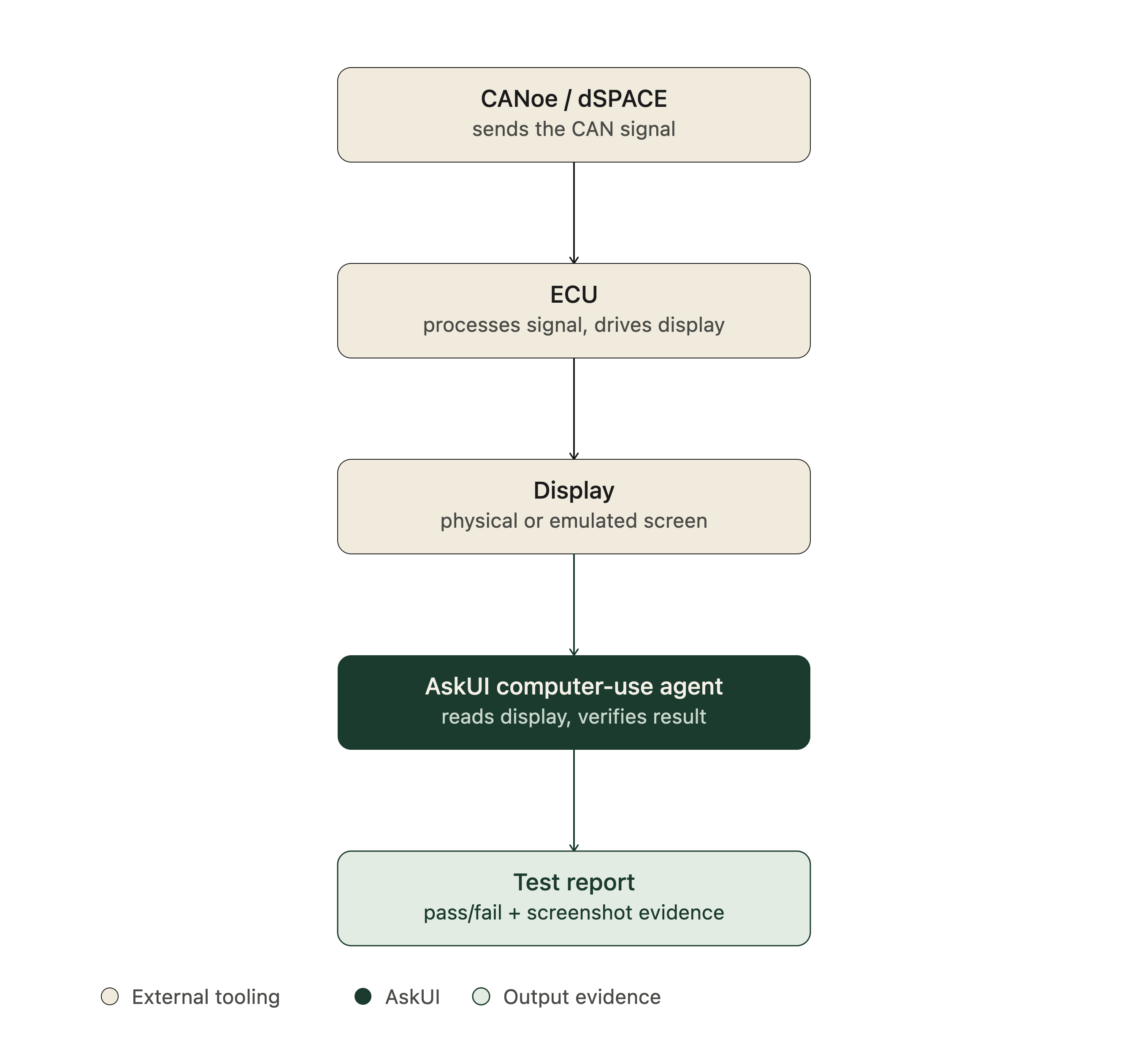
AskUI's computer-use agent executes test instructions against the display output directly, without requiring DOM access, accessibility hooks, or modifications to the ECU software under test.
In a typical HIL bench configuration, an external tool such as CANoe or dSPACE sends CAN signals to the ECU. AskUI reads the resulting display state and verifies that the correct visual output appeared, at the correct time, in the correct screen region. This is Signal-to-UI Verification at the HIL layer.
The execution layer reads the live display state on every run rather than replaying a fixed script. Because the agent interprets what's actually on screen at each step, a regression run doesn't depend on the exact pixel layout matching a prior run. If a display element moved or a software update changed the rendering, the agent still evaluates the current state against the expected result and logs what it saw.
Because AskUI deploys on-premise and is ISO 27001 certified with zero model training on customer data, it meets the data handling requirements common in automotive OEM and Tier 1 supplier environments. Teams can scale test projects like software across display variants, regional configurations, and hardware generations without rewriting test logic for each variant.
FAQ
What is the difference between HIL and SIL testing?
SIL (Software-in-the-Loop) runs compiled production code on a host PC against a simulated plant model. No target hardware is involved. HIL (Hardware-in-the-Loop) runs the same production code on the actual target ECU, connected to a real-time simulator that emulates the vehicle environment. The difference is execution environment: SIL cannot catch hardware-specific defects like timing violations, interrupt behavior, or driver faults. HIL can.
What does MIL stand for in MIL SIL HIL testing?
MIL stands for Model-in-the-Loop. It is the earliest test stage in the hierarchy, where the control algorithm model (typically in Simulink or a similar tool) runs against a simulated plant without any code generation involved. It validates the logical behavior of the algorithm before any software artifact is produced.
When should you move from SIL to HIL testing?
The move from SIL to HIL is appropriate when the class of defects you need to catch requires the target hardware context. This includes tests that depend on real-time timing, hardware peripheral behavior, watchdog supervision, or bus-level communication. For HMI display validation, HIL is required because the display hardware and its connection to the ECU are not present in a SIL environment.
Can HMI display validation be done in SIL?
Only partially. In SIL, you can validate the software logic that produces display outputs, but you cannot validate what actually renders on the physical display. Rendering defects, animation timing, and visual layout issues require the display hardware to be present, which means HIL or a dedicated display validation bench.
How does hil sil testing fit into ISO 26262 compliance?
ISO 26262 Part 6 maps software verification activities to specific test stages. SIL corresponds to software unit testing of the generated code, where structural code coverage (including MC/DC for ASIL C and D) is measured. HIL corresponds to software integration testing and, depending on bench configuration, software qualification testing. Each stage must produce traceable evidence linking test cases to safety requirements for audit purposes.