 YouYoung Seo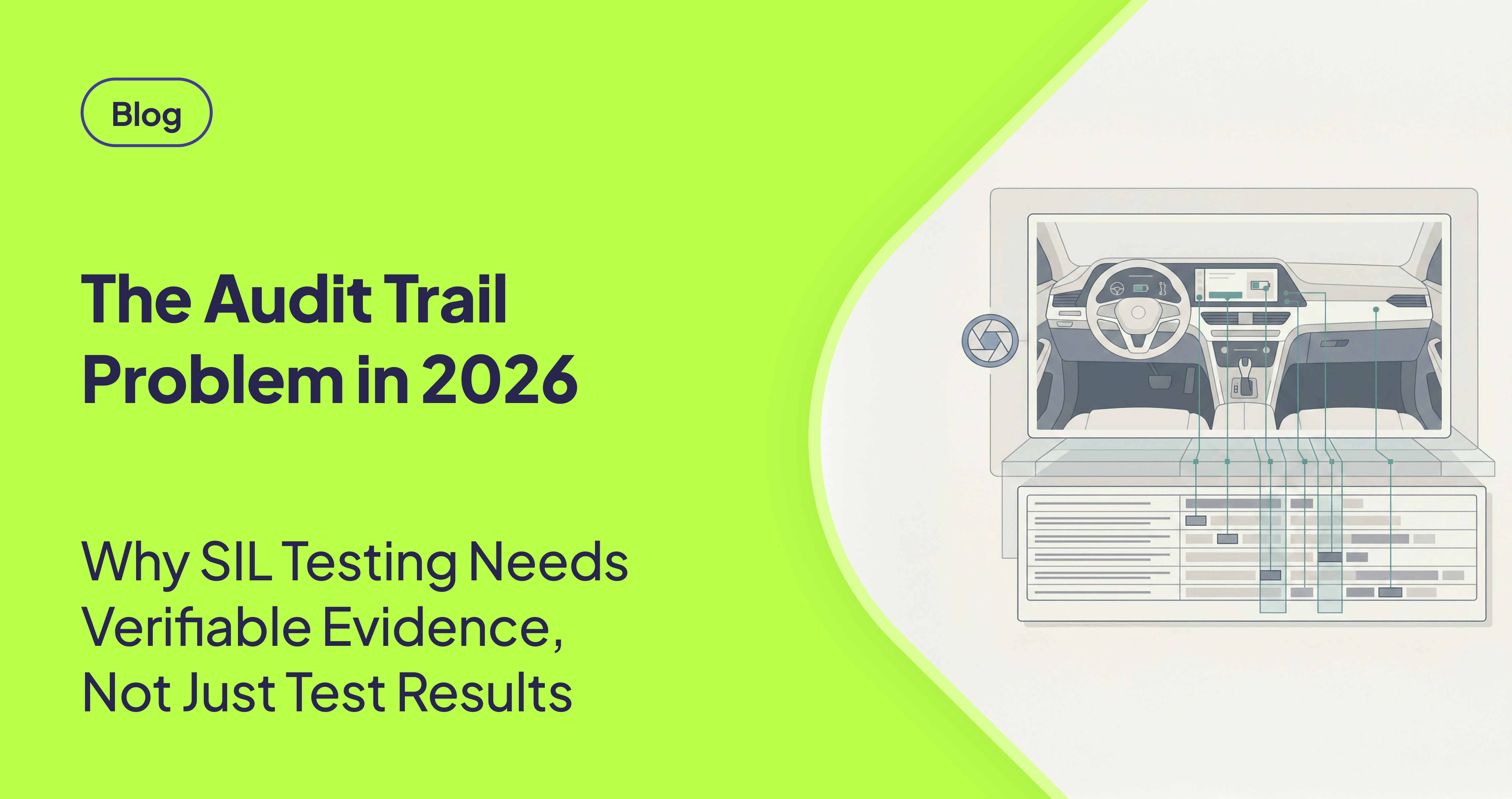
TLDR
In 2026, automotive software compliance is no longer just about passing tests, it is about the burden of proof. With the EU Product Liability Directive already in force (Directive (EU) 2024/2853) and its national implementation deadline set for 9 December 2026, manufacturers must deliver verifiable, well-structured evidence of software behavior. The current bottleneck lies in SIL (Software-in-the-Loop) testing, where correlating observed HMI behavior with captured system logs is slow and error-prone. AskUI’s Agentic AI acts as a Computer Use Agent that provides the infrastructure to synchronize UI interactions with system logs, enabling deterministic traceability and the generation of audit-ready artifacts as part of the testing process.
2026: A Critical Juncture in Software Accountability
In 2026, the global automotive landscape has reached a turning point where simply stating that “the platform works” is no longer sufficient. OEMs must produce an objective record of how the software stack behaved during validation.
This shift is driven by two major catalysts:
-
EU Product Liability Directive ( Directive (EU) 2024/2853): Formally adopted to replace the 1985 framework, this directive explicitly classifies software, including AI and OTA updates, as a product**.** EU member states are required to apply these rules by December 9, 2026, after which developers will face strict liability for software defects. This compels developers to maintain verifiable, synchronized system logs as a primary means of legal defense, as the absence of required logging can lead to a legal presumption of product defectiveness.
-
US Litigation & NHTSA Oversight: In the United States, NHTSA’s NCAP update roadmap and the discovery process in product-liability litigation are raising the bar for evidence, increasing pressure on OEMs to maintain verifiable links between HMI actions and synchronized platform data. Furthermore, the rigorous Discovery process in product-liability litigation allows injured parties to compel manufacturers to produce relevant evidence, including system records and testing data. Because complying with discovery rules is a notoriously difficult and expensive process for institutional defendants, maintaining a verifiable link between HMI behavior and platform data has become a critical survival strategy.
For engineering teams adhering to ASPICE and ISO 26262, the most significant challenge is the continuous generation and retention of the high-trust substantiation required for these assessments criteria.
The Evidence Gap: SIL Correlation Constraints
The most intensive validation occurs during the Software-in-the-Loop (SIL) phase. Here, engineers must prove that what a user observes on the screen, like the HMI, is consistently supported by the observed software behavior. However, a Evidence Gap persists:
- Manual Synchronization: Engineers frequently spend hours matching UI screenshots to specific timestamps in text-based API logs, a process prone to human error.
- Traceability Fragmentation: When UI observation and backend logging environments are disconnected, linking a specific UI state to an API response remains a manual challenge rather than a deterministic process
Agentic AI: The Computer Use Agent for Verifiable Testing
AskUI addresses this gap by acting as Computer Use Agent that interact with target environments across Windows, macOS, Linux, Android, and iOS observing HMI behavior and correlating it with captured system logs.
Instead of relying on brittle scripts or disconnected tools, AskUI operates at the interface level, recording what a user would see on the screen and aligning those interactions with corresponding backend events. This allows teams to move beyond manual correlation and establish a consistent, repeatable link between observed UI behavior and system activity, forming the foundation for verifiable, audit-ready testing workflows.
Traditional Validation vs Agentic Automation
| Compliance Metric | Traditional SIL Testing | AskUI Agentic AI |
|---|---|---|
| Proof Collection | Manual matching of screenshots and logs | Infrastructure for UI and API correlation |
| Data Integrity | Risk of manual errors or missing logs | Verifiable, well-structured evidence |
| Audit Readiness | Post-test report compilation (Days) | Automated generation of artifacts |
| Verification Focus | General functional testing | System behavior for safety assessments |
Conclusion: Engineering Trust through Automation
As we move deeper into the era of the Software-Defined Vehicle (SDV), the ability to produce a reliable audit trail is a competitive necessity. By adopting Agentic AI, automotive leaders can bridge the evidence between HMI behavior and software logs, reducing the manual documentation overhead and focusing on innovation.
With AskUI, compliance alignment moves beyond a collection of data to become verifiable proof of system integrity, a critical component of regulatory and legal documentation in 2026.
FAQ
Q: How does AskUI integrate with our current SIL testing workflows?
A: AskUI does not replace your functional testing tools, it complements them by adding a layer of visual observability. While your existing framework executes test logic, AskUI acts as a Computer Use Agent that observes the HMI and map visual states to backend system logs in real-time. This provides the missing link needed to turn raw test data into the structured evidence required for ASPICE or ISO26262.
Q: How does AskUI support the security of highly confidential, pre-release HMI designs?
A: AskUI provides the technical infrastructure necessary to protect your Intellectual Property (IP). Our architecture supports on-premise and private cloud deployments, which allows sensitive HMI visuals and captured data to remain within your organization’s secure internal network. By leveraging these offline-capable deployment options alongside our ISO 27001 certified standards, engineering teams can maintain full control and ownership over their data for even the most confidential projects.
Q: How does this automation reduce the operational effort required for compliance reporting?
A: The primary benefit is the elimination of manual correlation work. Instead of engineers spending days matching screenshots to API timestamps, AskUI generates pre-synchronized, indexed reports as part of the test execution process. This significantly reduces the time and effort required to assemble documentation for compliance reviews or discovery requests, allowing teams to focus on validation rather than evidence reconstruction.