

The previous two parts of this series established two things.
First: traditional test automation is deterministic. It resolves ambiguity through algorithms a closed set of selectors, conditions, and patterns written at a specific point in time. Everything outside that set fails.
When AI-Assisted Testing Is Not Enough
Second: there is a zone where classical automation fails entirely but computer-use agents can operate. Instructions that require contextual judgment. Environments with no accessible element structure. Test cases that describe outcomes rather than sequences of actions.
Why Traditional Test Automation Will Never Scale
That zone is large. And for most teams, it has been handled manually for years or not handled at all.
But there is a third thing worth establishing before this series ends.
Computer-use agents have a boundary too.
Where Even Intelligence Reaches Its Limit
Not every ambiguous instruction can be resolved by reasoning about a screen.
Some instructions are too underspecified for any system to act on reliably. Not because the system lacks capability, but because the instruction itself does not contain enough information to determine what success looks like.
Consider:
"Make sure the app is working correctly."
"Check that the user experience feels right."
"Verify that nothing looks broken."
These are not test cases. They are expressions of anxiety. No amount of visual reasoning resolves them, because success is undefined. A human tester would ask for clarification. A computer-use agent would too or worse, it would proceed with an assumption that may not match what the team actually meant.
This is the fourth zone on the complexity curve: instructions so ambiguous that even human-level judgment requires more context before acting.
The existence of this zone is not a limitation of agentic testing specifically. It is a limitation of underspecified requirements. The boundary is not a flaw in the approach it is a signal that the test case needs to be written better.
What Actually Changed
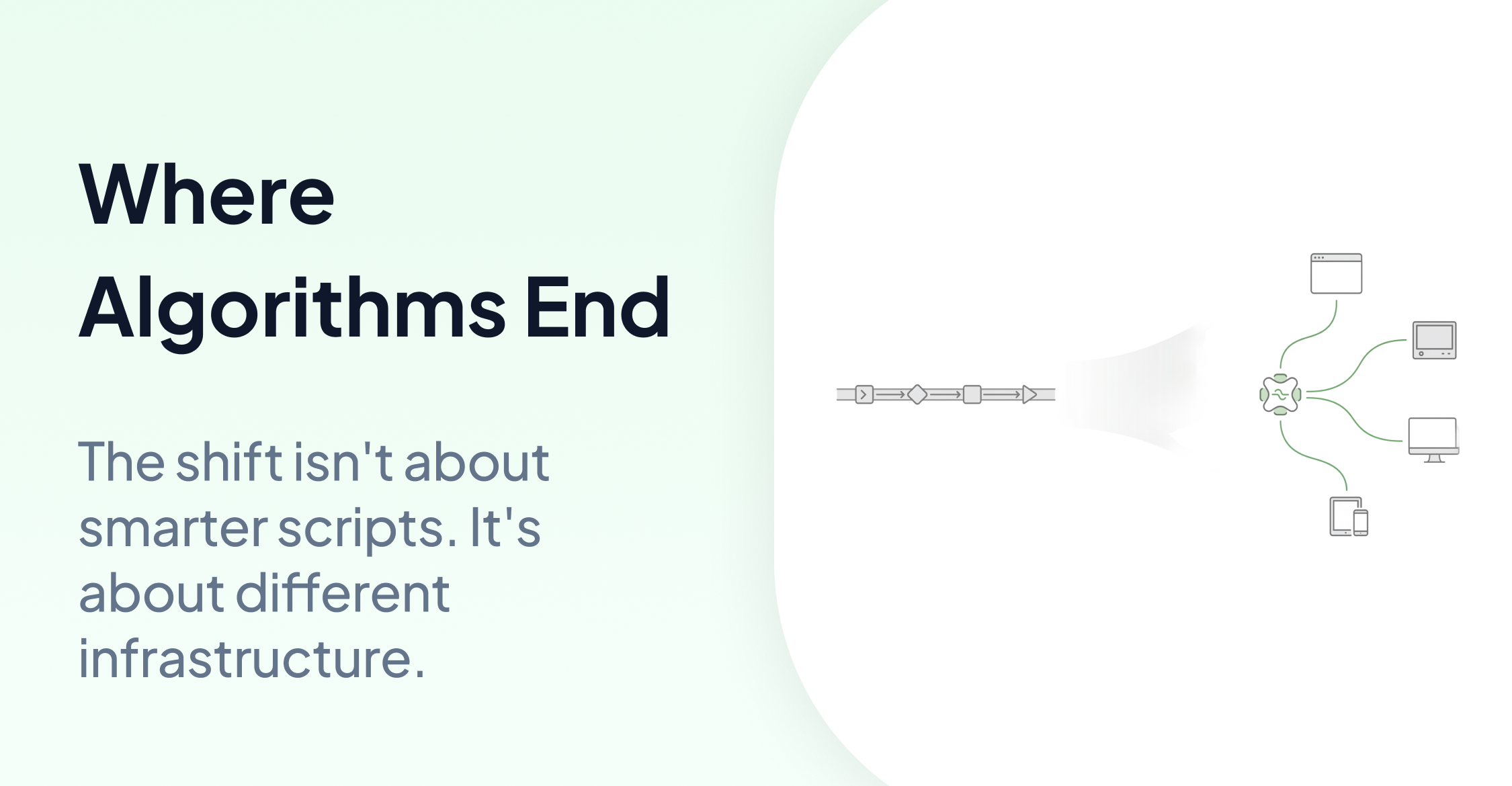
The shift from deterministic to intelligent testing is not primarily about what individual tests can do. It is about what the testing infrastructure can handle.
Deterministic automation infrastructure assumes a static relationship between instructions and actions. Every test maps to a fixed sequence. Every sequence maps to a fixed environment. Maintenance is constant because the relationship breaks every time the environment changes.
Intelligent testing infrastructure inverts this assumption. Instructions are expressed as goals. The system reasons about how to achieve them. When the environment changes when a UI updates, when a plugin panel restructures, when a new platform variant ships the tests do not break. The agent adapts.
This is not an incremental improvement to existing automation. It is a different model of how testing infrastructure relates to the software it tests.
In the deterministic model: tests describe what to do.
In the intelligent model: tests describe what to verify.
That distinction compounds over time. Teams running deterministic suites spend an increasing proportion of engineering capacity on maintenance as their products grow. Teams running intelligent infrastructure spend that capacity on coverage instead.
The Practical Difference at Scale
The implications show up most clearly when software complexity increases.
A team shipping a single web application can maintain a deterministic test suite with reasonable effort. But as the product grows across platforms, environments, and UI variants the maintenance surface grows with it. More selectors. More exceptions. More engineers keeping scripts aligned with a product that moves faster than the tests can follow.
Agentic testing infrastructure handles this differently. The same agent that tests a web interface can test an embedded plugin panel, an HMI display, a legacy desktop application, or a voice interface because it does not rely on selectors or DOM access. It relies on what is visible on screen and what the instruction asks it to verify.
Scale your test projects like software. The instruction set grows with the product. The infrastructure adapts.
What This Means for How Teams Write Tests
The shift to intelligent infrastructure changes how test cases should be written not just how they are executed.
Deterministic test cases were written to be executable by a script. Every ambiguity had to be resolved at authoring time, because the script had no mechanism to resolve it at runtime.
Intelligent test cases can be written to describe intent. The ambiguity that previously had to be stripped out the contextual judgment, the outcome-based framing can now stay in. The agent resolves it at runtime, the same way a human tester would.
This means the coverage gap described in Part 2 is recoverable. Not by rewriting existing scripts, but by writing new tests the way a human would naturally describe them.
"Verify the onboarding flow completes correctly."
"Confirm the dashboard reflects the updated data."
"Check that the plugin panel responds to the UXP migration."
These are now executable. Not because the scripts got smarter. Because the infrastructure underneath them changed.
The Infrastructure Layer
What makes this possible is not any single model or any single agent. It is the infrastructure that connects instructions to execution across environments that classical tools could never reach.
That infrastructure needs to handle more than screenshots and clicks. It needs to connect to device interfaces, CAN bus signals, shell commands, external APIs, and CI pipelines. It needs to run on embedded HMIs, physical devices, and air-gapped environments. It needs to produce evidence trails that meet audit requirements in regulated industries.
AskUI is built as that infrastructure layer. Not a test script generator. Not a selector replacement. An execution environment for computer-use agents that need to operate reliably across the full range of environments that modern software ships into.
The shift from algorithmic to intelligent testing is not a product decision. It is an infrastructure decision. The teams making it now are not replacing their existing automation they are extending it into the zone where deterministic tools stop working.
That zone, as this series has argued, is larger than most teams realize.
FAQ
What is the difference between agentic testing and traditional test automation?
Traditional test automation is deterministic: it maps actions to fixed selectors and conditions written at authoring time. Agentic testing uses computer-use agents that reason about instructions at runtime, allowing them to handle ambiguous test cases and environments where selectors are unavailable.
What kinds of instructions are too ambiguous even for computer-use agents?
Instructions that do not define what success looks like. "Make sure the app is working" or "check that nothing looks broken" cannot be acted on reliably by any system human or machine without further specification. These are requirements problems, not testing problems.
Does agentic testing replace deterministic automation?
No. Deterministic automation handles well-defined, stable test cases efficiently. Agentic testing extends coverage into the zone where deterministic tools fail. The two approaches are complementary and typically run alongside each other in mature testing infrastructure.
What environments can computer-use agents test that classical tools cannot?
Any environment where there is a visible interface but no accessible element structure: embedded plugin UIs, HMI displays, legacy desktop applications, kiosk interfaces, and physical device screens. Computer-use agents interact with what is visible, not with what is accessible through a DOM or selector tree.
What is AskUI?
AskUI is infrastructure for computer-use agents. It provides the execution environment, device connectivity, model routing, caching, reporting, and CI integration that teams need to run agentic testing reliably in production across desktop, embedded, mobile, and HMI environments.
The Frontier Has Moved
Three parts ago, the argument was simple: traditional test automation has a structural ceiling. It cannot handle what it was not explicitly programmed for.
That ceiling has not moved. But the floor of what is now automatable has risen dramatically.
The zone between the classical frontier and the CUA frontier the instructions that require judgment, the environments that have no selectors, the test cases that describe outcomes rather than actions is now within reach.
Not because testing got easier. Because the infrastructure underneath it changed.