

TLDR
AI agents have moved from experimental tools to production infrastructure for system validation. Gartner predicts that 40% of enterprise applications will embed task-specific AI agents by end of 2026, up from under 5% in 2025. A big part of that shift is happening in industries where traditional automation never worked in the first place: embedded devices without APIs, locked-down production builds, industrial HMI panels, and hardware endpoints across desktop, mobile, and specialized displays.
This post covers how AI agents are being applied for functional validation across these industries, and why the hardware world is where this technology makes the biggest difference.
How These AI Agents Actually Work
Unlike traditional automation tools that read an application's source code or internal object model, these agents interact with the screen the same way a human does. Powered by Large Language Models, they go beyond pixel matching: they interpret what's on screen in context, distinguishing a temperature icon from a volume icon based on the surrounding interface, not just its shape. They identify UI elements (buttons, input fields, labels, icons) and perform actions like clicking, typing, or verifying that something rendered correctly.
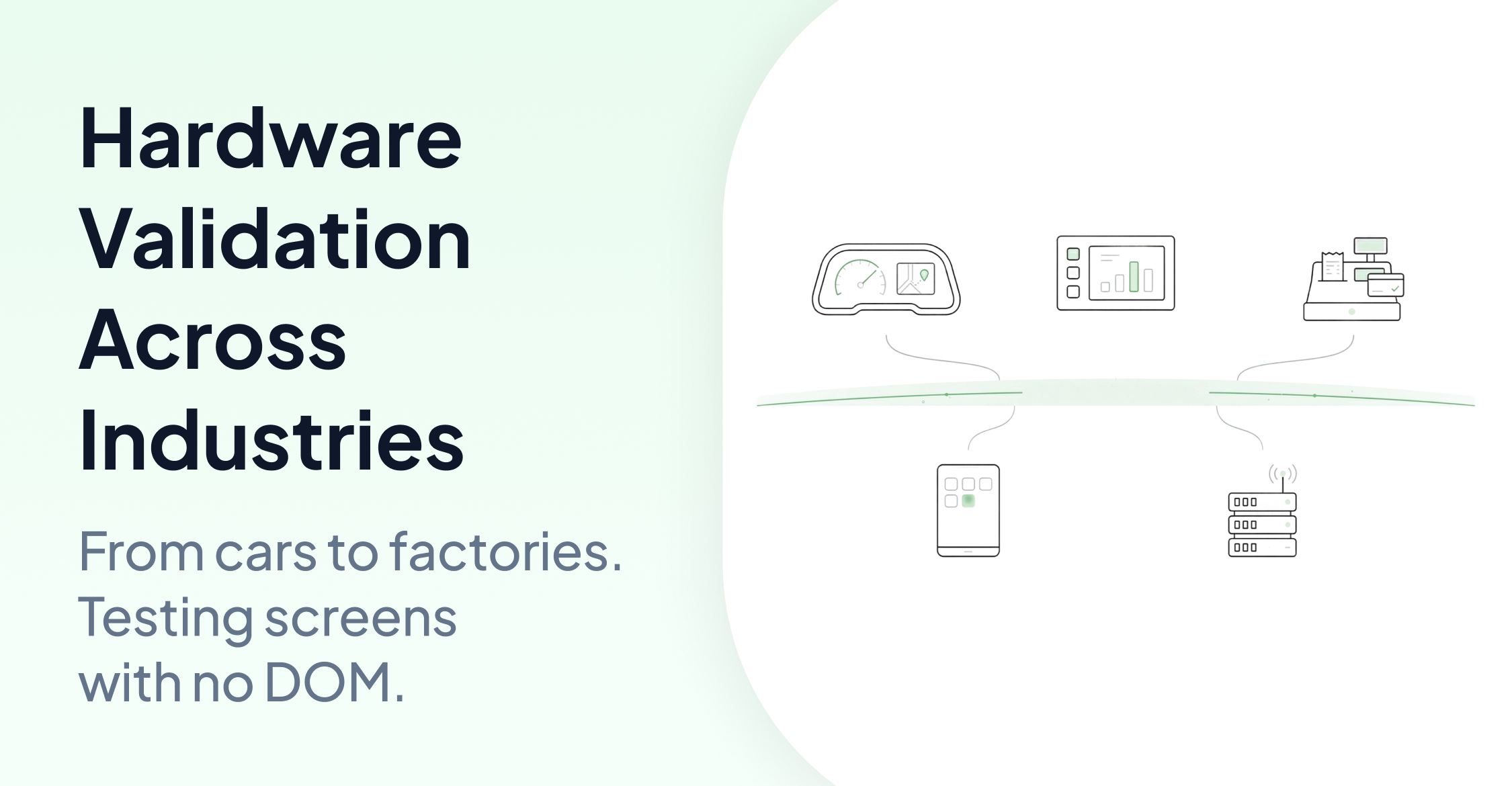
This matters because many enterprise environments don't expose internal element structures. Embedded systems, industrial HMI panels, automotive digital clusters, POS terminals, and smart device displays often have no DOM, no XPath, and no accessible automation hooks. Traditional test automation tools simply cannot operate in these environments. And legacy pixel-comparison approaches, while they can access these screens, break the moment a font size changes or a screen renders at a different resolution. Screen-based AI agents solve this by working at the interface layer, the same layer the human user interacts with, but with the ability to reason about what's on screen rather than just compare pixels.
AI Agents vs. Traditional Automation at a Glance
| Aspect | Traditional Automation | AI Agents (Screen-Based) |
|---|---|---|
| Element identification | DOM selectors, XPath, object IDs | Perceives UI elements directly on screen |
| Platform dependency | Tied to specific frameworks | Works on any device (desktop, mobile, embedded) |
| Legacy system support | Requires accessible object model | Only needs a visible interface |
| Script maintenance | Hard-coded per project, breaks across variants | Scales across hardware variants without rewriting |
| Cross-platform | Separate scripts per platform | Single approach across all surfaces |
| Setup complexity | Requires instrumentation hooks | Non-invasive, no code changes to target system |
Industry Applications in 2026
1. Automotive: Digital Cockpit and Infotainment Validation
Modern vehicles run complex infotainment systems (IVI) and digital cockpits that display navigation, media, climate controls, and vehicle diagnostics on interconnected screens. Testing these systems is fundamentally different from testing a web application.
The challenge: In automotive HIL (Hardware-in-the-Loop) and SIL (Software-in-the-Loop) test environments, engineers simulate backend signals (like CAN bus messages) to trigger UI states on the digital cluster. The signal simulation itself is straightforward. The hard part is automatically verifying that the correct visual output actually appeared on screen, especially since these embedded displays don't provide DOM-style selectors.
How AI agents help: AI agents can verify the rendered UI state after signals are sent, closing the loop between backend simulation and the screen output. This replaces manual visual checks that previously required engineers to physically sit in front of test benches. Test logic can be reused across different vehicle variants and hardware configurations without rebuilding scripts from scratch.
AskUI's role: AskUI provides infrastructure for running AI agents on automotive test benches, supporting IVI system testing, navigation verification, and digital cockpit validation. The platform integrates with existing HIL/SIL toolchains rather than replacing them.
2. Manufacturing: HMI Testing and SCADA Validation
Manufacturing relies heavily on Human-Machine Interfaces (HMIs) and SCADA (Supervisory Control and Data Acquisition) systems to monitor and control production lines. These systems form part of a deeply interconnected architecture, from sensors and PLCs at the floor level to MES and ERP systems at the enterprise level.
The challenge: HMI screens are connected to backend systems through complex dependency chains. Testing a single screen element may require specific sensor states, PLC configurations, and network conditions to all be in place simultaneously. Traditional automation tools struggle because industrial HMI environments typically don't expose the kind of object models that web-based tools require.
How AI agents help: AI agents can interact with HMI panels and SCADA interfaces the same way a human operator would, by perceiving the screen and acting on what they see. This enables automated testing across diverse hardware platforms (QNX, WinCC, custom RTOS) without needing platform-specific instrumentation.
AskUI's role: AskUI supports HMI panel testing, SCADA system verification, and production line software integration. The approach works across different industrial display technologies without requiring code-level access to the control systems.
3. Retail: POS Systems and Kiosk Validation
Retail operations depend on reliable POS (Point of Sale) terminals, self-checkout kiosks, and in-store display hardware working correctly across multiple store formats and geographies.
The challenge: POS systems are often proprietary hardware/software combinations that don't expose automation-friendly interfaces. Retailers operating in multiple countries need to verify the same in-store checkout flow works correctly in 25+ language variants across different POS hardware. Traditional test automation requires hard-coding scripts for each variant, a maintenance nightmare that doesn't scale.
How AI agents help: AI agents can interact with POS terminals and self-service kiosk interfaces regardless of the underlying technology. Because the agent identifies elements by their appearance rather than by code structure, the same test logic can be deployed across different POS hardware, languages, and display configurations without rebuilding scripts.
AskUI's role: AskUI supports POS terminal validation, self-checkout kiosk testing, and customer-facing display verification across hardware variants and regional configurations.
4. Consumer Electronics: Smart Device Interface Validation
Consumer electronics manufacturers ship products with embedded displays: smart TVs, washing machines with touchscreen panels, refrigerators with home hub interfaces, smart thermostats, fitness trackers, and home audio systems. Each product line has multiple hardware variants, regional firmware builds, and display sizes that all need to render the same UI correctly.
The challenge: Smart device interfaces run on lightweight embedded systems (often custom Linux, Android-based RTOS, or proprietary firmware) with no standard automation hooks. A smart TV manufacturer may need to validate the same menu system across dozens of models with different screen resolutions, chipsets, and remote control input methods. A washing machine's touchscreen panel needs to display the correct cycle options and status indicators for every regional variant. Testing each combination manually is slow and doesn't scale with the pace of product releases.
How AI agents help: AI agents interact with the device display directly, navigating menus, verifying that settings render correctly, and confirming that the UI responds appropriately to inputs. The same test logic can validate a smart TV interface across different hardware models without writing separate scripts for each one.
AskUI's role: AskUI supports functional validation of embedded consumer device interfaces across hardware variants and screen sizes, applying the same screen-based approach used in automotive and manufacturing.
5. Telecommunications: Network Equipment and Set-Top Box Validation
Telecom companies deploy millions of hardware endpoints: set-top boxes, routers with admin interfaces, network management consoles, and field technician devices. Each runs embedded software that needs to be validated across hardware generations and regional configurations.
The challenge: Set-top box interfaces, router admin panels, and network management consoles run on proprietary embedded systems. The UI must be validated on every hardware variant, and these devices don't expose standard automation hooks. The sheer number of variants (different chipsets, screen sizes, software branches) makes manual testing impractical.
How AI agents help: AI agents can interact with set-top box menus, router interfaces, and network consoles directly on the device screen, verifying that channel guides render correctly, settings menus are functional, and error states display properly across hardware variants.
The Scalability Factor
One of the most significant shifts in 2026 is how organizations think about test automation scaling. The old model was: new project, new scripts, new maintenance burden. This created a linear relationship between growth and QA cost.
AI agents change this equation. Because the agent identifies elements by their appearance rather than code structure, the same test logic can often be reused across variants, languages, and platforms. A test suite built for one POS system can be deployed to 25 country variants without rebuilding the underlying scripts.
For manufacturing and automotive, this means the same validation approach works from early software simulation (SIL) through physical hardware testing (HIL), reducing the setup effort that traditionally consumed more time than the actual testing.
What to Look for When Evaluating AI Agents
Based on how enterprise clients are evaluating these tools in 2026:
-
Token cost and execution efficiency: How much does each test run cost? Does the platform use caching or optimization to reduce redundant AI processing?
-
Speed of execution: Can the system handle high-frequency regression testing, or is each run slow enough to create a bottleneck?
-
Maintainability: When the application under test changes, how much manual work is required to update the test suite? Because the agent understands the intent of each test step through LLM-based reasoning, it can adapt when a button moves or a label changes without the test breaking.
-
Scalability: Can existing test logic be deployed to new projects, new hardware variants, or new languages without starting from scratch?
-
Readability: Can team members beyond automation engineers (QA leads, system engineers, product managers) understand and contribute to test logic?
Beyond These Five Industries
The same validation approach applies wherever there's an embedded display and a test bench. Defense (drone controller HMIs), MedTech (dialysis machine interfaces), railway (driver cab displays), and NEV (battery management and charging displays) all share the same HIL-based testing challenge. The industry changes, but the problem doesn't. Verify that the system renders the correct output on a closed, embedded screen.
Conclusion
AI agents for system validation are no longer experimental. They're production infrastructure running across automotive test benches, factory HMI panels, retail POS terminals, smart home devices, and telecom set-top boxes. The common thread: these are all hardware with embedded displays that traditional automation tools simply cannot access.
By working at the interface layer, the same layer a human engineer or operator uses, AI agents can validate any device that has a screen. No DOM required. No API required. No instrumentation required.
For engineering teams evaluating this technology, the question has shifted from "does this work?" to "how fast can we scale validation across our hardware fleet?"
FAQ
What is an agentic testing agent?
It's a reasoning-based AI system that perceives and interacts with device interfaces on screen (buttons, text, icons, menus) without requiring access to the application's underlying code or object model. Instead of following hard-coded scripts, it reasons about what's on screen and performs functional validation the way a human engineer would.
How is this different from traditional RPA?
Traditional RPA tools automate business process workflows (data entry, form filling, report generation) for office workers. AskUI is built for a different use case entirely: functional validation of hardware and embedded system interfaces for QA and system engineers. The underlying technology (perceiving and interacting with screens without needing DOM or API access) may sound similar, but the target user, the target environment, and the business problem are fundamentally different.
What industries benefit most from agentic testing?
Industries that ship hardware with embedded displays benefit most: automotive and NEV (digital cockpit and IVI validation on HIL/SIL benches), manufacturing (HMI panel and SCADA testing), defense, railway, MedTech, retail (POS system testing across hardware variants), consumer electronics, and telecommunications.
Does AskUI replace existing automation tools?
No. AskUI integrates with existing toolchains rather than replacing them. In automotive environments, for example, AskUI works alongside existing simulation tools (like CANoe or dSPACE) to verify the rendered output after signals are sent.
What about security and compliance?
AskUI is ISO 27001 certified and GDPR compliant. The platform supports on-premise deployment for organizations that require data to stay within their network.
How does scalability work?
Because agents identify elements by their appearance rather than by hard-coded selectors, test logic can be reused across different projects, platforms, languages, and hardware variants without rebuilding from scratch. This is particularly valuable for global deployments (e.g., POS systems in 25+ countries).