

TLDR
For Tier-1 suppliers, UI fragmentation quietly erodes project margins, forcing teams to rebuild and maintain the same test logic for every OEM brand. AskUI’s Zero-Shot Scalability leverages Agentic AI to understand visual context, enabling a single abstracted test logic to validate different brand UIs instantly. Stop duplicating scripts and maximize your margins through strategic asset reuse.
The Multi-OEM Challenge: Where Scaling Breaks Down
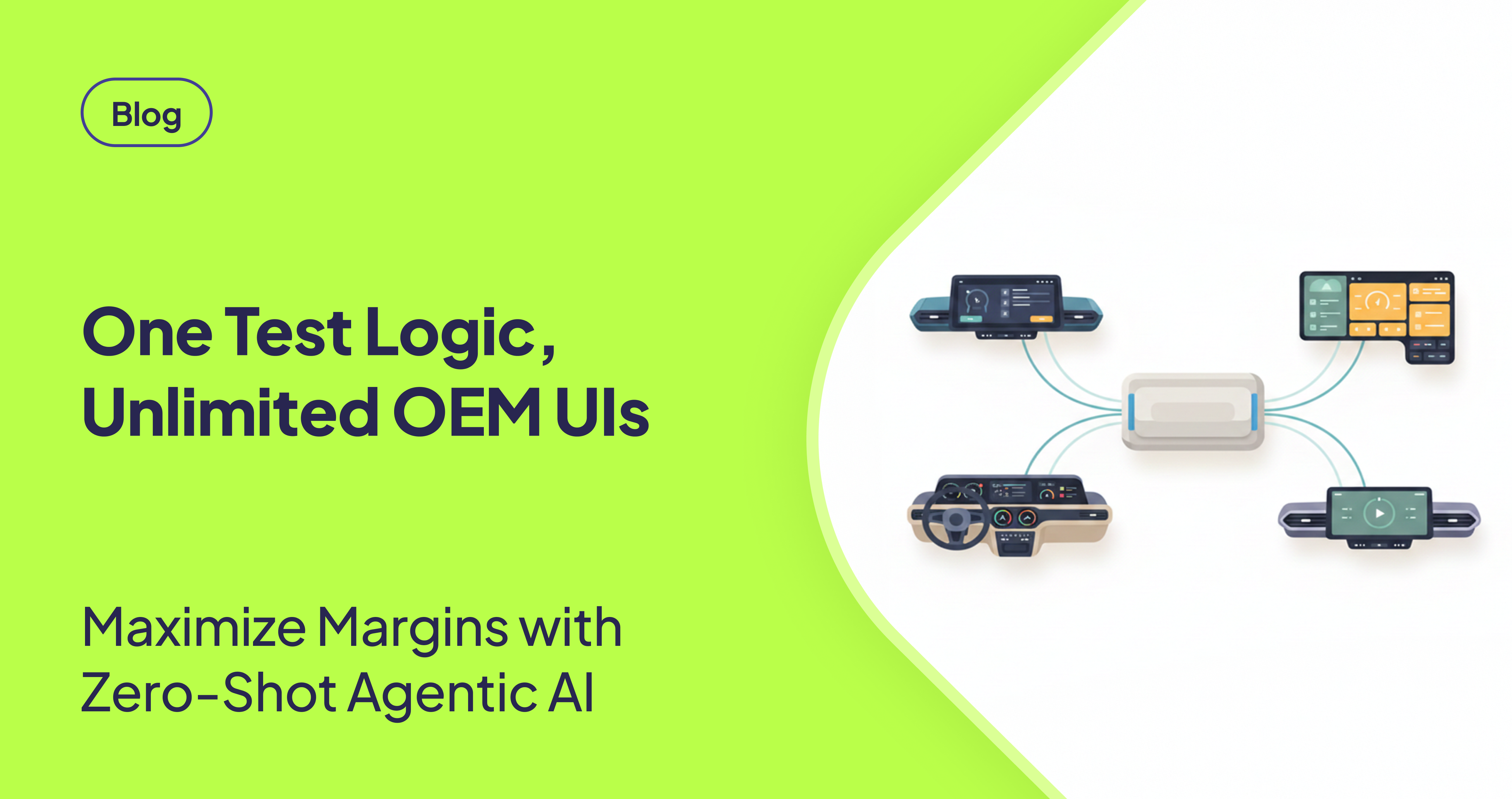
Global Tier-1 suppliers in Germany and the US often manage multiple OEM programs simultaneously. While the core software logic remains consistent, each OEM demands a unique brand identity, resulting in vastly different layouts and designs for IVI (In-Vehicle Infotainment), clusters, and HUDs.
Traditionally, this meant building separate test suites for every OEM. In a fixed-price or capped T&M project model, this “script multiplication” eats into margins and creates a maintenance nightmare. Every minor UI tweak by an OEM triggers a chain reaction of broken tests across all variants, resulting in massive maintenance overhead that slows delivery.
1. Zero-Shot Inference: Bridging the Visual Gap with VLM
The term “Zero-Shot” in AskUI refers to the agent’s ability to interact with a UI it has never encountered before, without needing specific training data or element IDs for that particular version. By leveraging a Vision Language Model (VLM), the agent performs real-time visual inference, understanding that a “gear icon” in Brand A and a “Settings” label in Brand B serve the same functional purpose.
- Logic over Coordinates: Instead of hardcoding “Click at (X, Y),” you define a functional goal.
- Contextual Adaptability: The VLM maps your high-level test logic to the specific visual layout of any OEM skin during execution. This enables functional consistency without the need for manual script adjustments, even when UI elements vary significantly across brands.
2. The Economics of Asset Reuse
For a Tier-1 supplier, test asset portability is a financial imperative. AskUI allows you to abstract your test logic away from the implementation layer, turning QA into a reusable asset.
- Eliminate Redundancy: Instead of maintaining ten versions of the same test, you maintain one master logic.
- Proven ROI: As demonstrated in the SEW-Eurodrive case study, teams managing high-density system testing achieved up 250% ROI and 60%% time savings by unifying fragmented environments under AskUI.
3. Technical Authority: SOTA Performance in OSWorld (66.2)
AskUI’s reliability is backed by world-class performance data. In the OSWorld benchmark, the industry standard for evaluating autonomous computer use, AskUI achieved a State-of-the-Art (SOTA) score of 66.2.
Ranking among the top performers globally, AskUI demonstrated industry-leading capabilities in executing complex, multi-step workflows across real operating systems, including Ubuntu, Windows, and macOS, demonstrating robustness and standing out among current autonomous agents.
4. Why This Isn’t Just AI Magic: The Hybrid Execution Model
To meet the reliability and consistency requirements of automotive testing, AskUI employs a Hybrid Execution Model that combines agentic intelligence with deterministic execution paths.
-
Discovery(Zero-Shot): The Vision Language Model (VLM) uses visual reasoning to identify and map the optimal interaction path for new OEM UI.
-
Stabilization(Deterministic): Once validated, this path is converted into a reusable trajectory for consistent, high-speed execution across environments.
This approach delivers the flexibility of autonomous agents with the reliability of traditional automation, enabling native-speed execution without the latency of continuous AI reasoning.
FAQ
Q1: Does Zero-Shot inference increase test execution time?
A: The initial Zero-Shot discovery phase takes slightly longer as the Vision Language Model (VLM) analyzes the UI. However, this step is performed only once. Through AskUI’s Hybrid Execution Model, validated interaction paths are converted into deterministic trajectories. Subsequent test runs execute at native speed without repeated AI reasoning latency.
Q2: How does AskUI handle safety-critical UI elements?
A: AskUI combines visual inference with strict validation logic. Teams can define visual anchors, textual assertions, and verification rules to ensure that safety-critical elements, such as ADAS warnings or system alerts are consistently detected and validated during the stabilization phase. This enables high reliability for regulated automotive environments.
Q3: Can AskUI be deployed on-premise for data security?
A: Yes. AskUI is ISO 27001 certified and supports on-premise deployment. This helps ensure that sensitive OEM UI designs and proprietary HMI logic remain within your secure infrastructure, fully complying with automotive security and data protection requirements.
Q4: Can the same test logic run across Android Automotive and Linux-based IVI systems?
A: Yes. AskUI operates as an Agentic AI infrastructure. By leveraging Zero-Shot visual reasoning, the agent perceives the interface just as a human does, without depending on underlying OS code or accessibility labels. As long as the functional intent is visually present, for example, “Set temperature to 22°C”, the agent autonomously identifies the interactive elements and executes the goal consistently across any operating system or OEM UI implementation.