 YouYoung Seo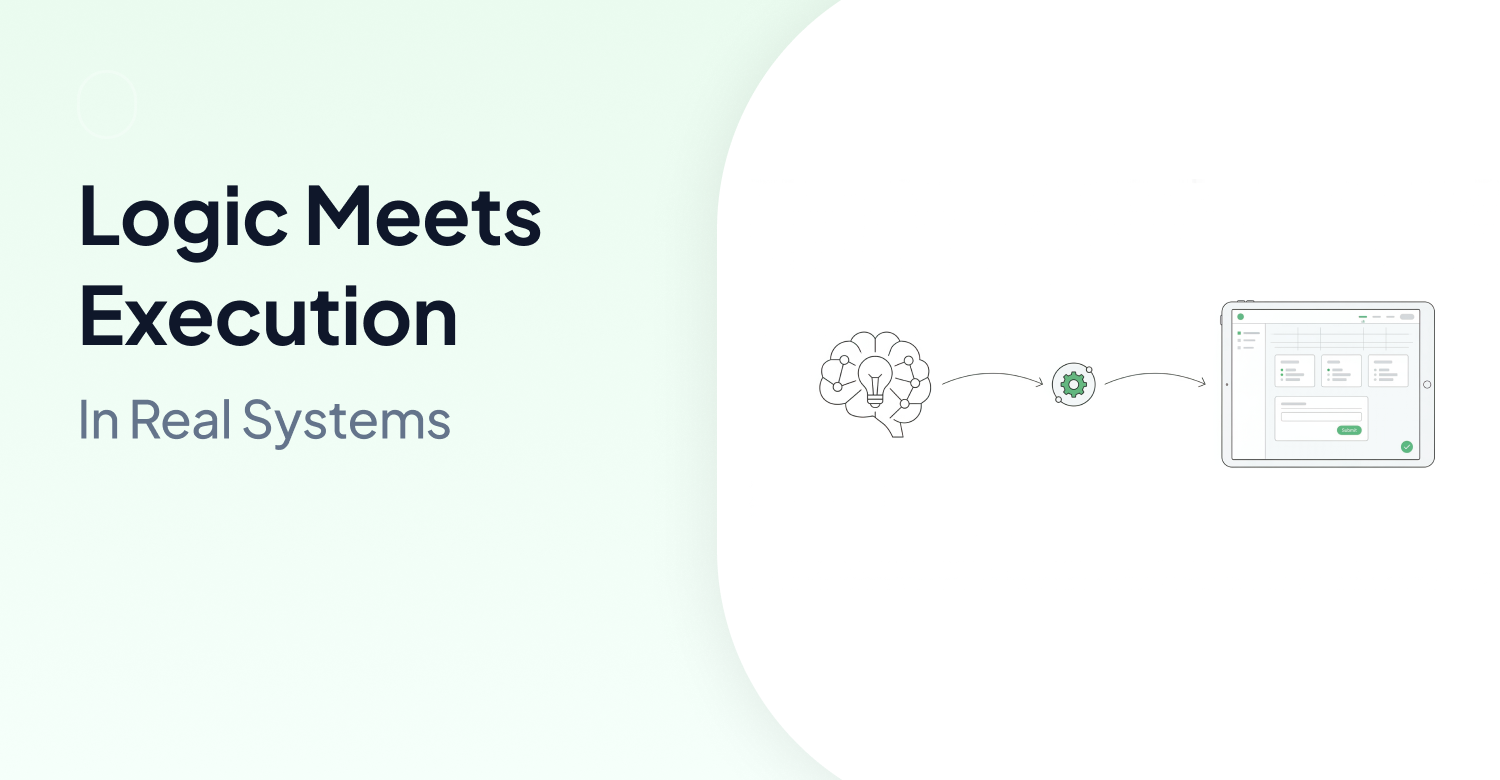
Executive Summary
Advances in AI reasoning are accelerating the development of autonomous agents across enterprise systems.
Large language models provide powerful pattern recognition and language capabilities. Neurosymbolic AI introduces structured reasoning by combining neural perception with symbolic logic.
These advances improve how agents decide what should happen.
However, decision-making alone does not produce reliable systems. Agents must still interact with real software environments, operating systems, and device interfaces.
Reliable agent systems require execution infrastructure that can translate decisions into real actions.
AskUI provides the execution layer that enables this interaction.
The Evolution of AI Reasoning
Traditional symbolic AI relied on explicit rules and handcrafted knowledge. This approach provided strong logical reasoning but struggled with real-world variability.
Deep learning changed this landscape. Neural networks excel at extracting patterns from large datasets. This enabled breakthroughs in areas such as image recognition, language understanding, and speech processing.
However, neural systems are primarily statistical. They infer likely outcomes rather than applying strict logical constraints.
Neurosymbolic AI attempts to combine the strengths of both approaches.
What Is Neurosymbolic AI
Neurosymbolic AI integrates neural perception with symbolic reasoning.
Neural models interpret complex inputs such as images, text, or interface elements. Symbolic systems apply logical rules that govern relationships between concepts.
For example, an agent interacting with a user interface might process the environment as follows:
- Perception: a submit button and an email field are visible
- Rule: a form requires a valid email address before submission
- Decision: enter an email before triggering the submit action
This combination allows AI systems to reason about constraints while still learning from data.
Neurosymbolic systems also improve explainability because logical reasoning chains can be traced and audited.
Why Reasoning Alone Is Not Enough
Even with improved reasoning models, agents still face a practical challenge.
Reasoning determines what should happen. Execution determines whether that action can actually occur.
Enterprise environments often include:
- desktop applications
- embedded device interfaces
- legacy enterprise software
- virtualized environments such as Citrix or VDI
- workflows that span multiple operating systems
An agent may reason correctly about the next step but still fail when interacting with real systems.
This gap between decision and action is where many agent systems break down.
The Missing Layer in Agent Architectures
Reliable agents require a clear separation between reasoning and execution.
Reasoning models determine what should happen next. Execution infrastructure carries out those actions across real systems.
AskUI provides this execution layer.
With AskUI, agents can:
- observe the current interface state during runtime
- interact with software across operating systems
- verify that actions actually succeeded
- continue workflows based on confirmed system outcomes
This architecture allows reasoning models to operate reliably in real environments.
Whether the reasoning engine is based on LLMs, neurosymbolic systems, or other approaches, the agent still requires execution infrastructure.
Building Reliable Autonomous Agents
As agent capabilities evolve, the architecture of AI systems is becoming clearer.
Reliable agents require two complementary layers.
The reasoning layer determines decisions under uncertainty and enforces logical constraints.
The execution layer ensures those decisions translate into reliable actions across real software systems.
This separation allows organizations to combine advanced reasoning models with stable operational infrastructure.
FAQ
1. Does neurosymbolic AI replace large language models?
No. Neurosymbolic systems and LLMs address different aspects of intelligence. LLMs are highly effective for language and pattern recognition. Neurosymbolic approaches are useful when structured reasoning and explicit rules are required.
2. Why is execution infrastructure still necessary?
Reasoning models can determine the correct action, but agents must still interact with real interfaces and systems. Execution infrastructure ensures those actions can be carried out reliably.
3. Where does AskUI fit in an agent architecture?
AskUI operates as the execution layer. It enables reasoning models to translate decisions into real interactions across operating systems and software interfaces.
Conclusion
Advances in reasoning models are expanding what AI agents can understand and decide.
Neurosymbolic AI improves logical reasoning. Large language models improve pattern recognition and language capabilities.
Reliable agents require more than intelligence.
They require the ability to execute decisions across real systems.
AskUI provides the execution infrastructure that enables AI agents to translate decisions into reliable actions across software systems and interfaces.