 YouYoung Seo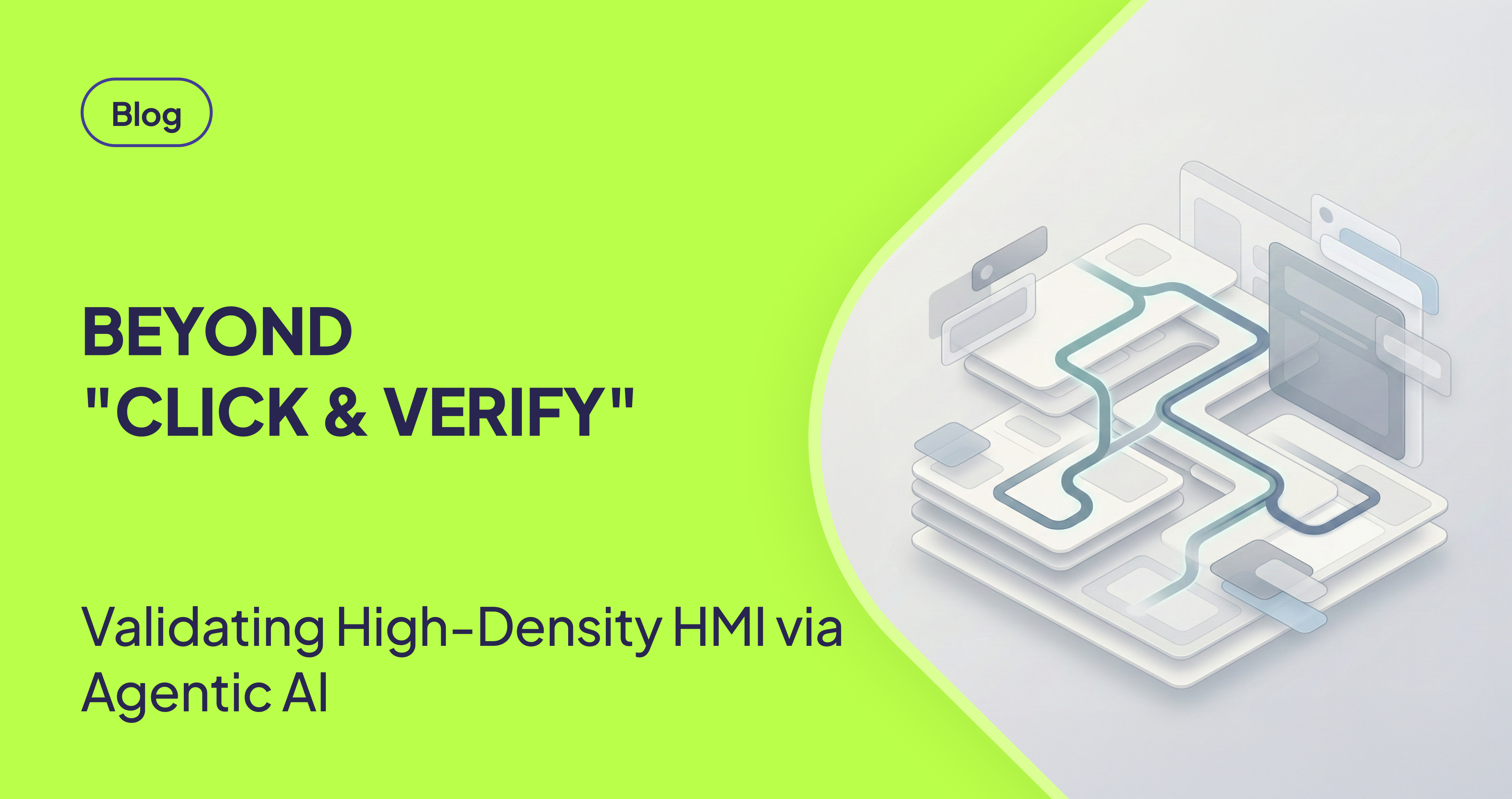
TLDR
In the 2026 era of Software-Defined Vehicles (SDVs), Click-and-Verify is no longer a viable strategy for high-density HMI logic. AskUI’s Computer Use Agents transcend static automation by reasoning through UI-visible software states in real-time, validating the deepest functional branches that remain unreachable for legacy tools/
The End of Click-and-Verify in the Age of Dynamic HMIs
Modern Human-Machine Interfaces (HMI) from automotive cockpits to critical industrial dashboards have transformed into high-density state machines. In this environment, a UI is not just a collection of buttons, it is a complex web of conditional logic flows.
Legacy automation scripts fail because they rely on static object trees and hardcoded selectors. When testing deep functional branches, these scripts lack the situational awareness needed to handle 2026-standard complexities like contextual overlays or real-time system alerts. To validate the state machine, we must move beyond mechanical execution toward Agentic Automation.
Agentic Pathfinding : Reasoning-Driven QA
At the core of AskUI is a shift to Reasoning-Driven QA.
Instead of following a predefined path, AskUI’s Computer Use Agents evaluate the visible software state before every interaction. This marks the transition from blindly clicking to intelligent pathfinding.
- State-aware navigation
Before progressing through a flow, the agents evaluate whether the current UI state permits the next action. A disabled control is interpreted not as a failure, but as a potentially correct outcome enforced by UI-level constraints such as lockouts or policy conditions.
- Autonomous Decision Making
When unexpected pop-ups, overlays, or timing delays appear, the agents reason through the new state and recalculate the execution path, maintaining test continuity without brittle retries or hard-coded exceptions.
- Logic-First validation
Rather than validating surface-level UI presence, the agents confirm that user actions consistently produce the correct transition across the entire functional tree, even as layouts and conditions shift in real-time.
Engineered for Precision: AskUI’s Computer Use Infrastructure
To support this level of reasoning across Windows, macOS, Linux, Android, and iOS, AskUI gives a specialized computer use infrastructure that acts as the intelligent execution layer for QA.
| Component | Role | Validation Value |
|---|---|---|
| AI Agents | Goal-driven reasoning engine | Validates UI-enforced logic and decision paths |
| Agent OS | Device-level controller | Synchronizes agent actions with rendered system state |
| Agentic Perception | Code independent UI understanding | Enables self-healing as layouts and flows change |
| AskUI agent library | Python-based open-source interface | Bridges test intent with executable interactions |
This infrastructure allows agents to reason about UI state and execute actions with precision across complex environments.
Practical Scenario: Validating UI Enforced System Constraints
To illustrate, consider a 2026 SDV update scenario. To reach an Install toggle within the cockpit UI, computer use agents must navigate several layers of system setting. The interface only enables this action when specific pre-requisites are visibly satisfied:
- Vehicle state is Park.
- Battery state is High Voltage Ready.
- Connectivity status is Verified
A traditional script encountering a disabled toggle would fail with a missing element error. However, AskUI’s agents evaluate the visible context, identify that the interface is enforcing UI-level safety interlocks, and validates that system conditions are accurately reflected and consistently applied at the interface level.
Conclusion: Setting a New Standard for Quality
As HMI logic becomes deeper and more conditional, reliable validation requires agents that can reason through visible software logic. Deep functional navigation is not about finding buttons, it is about proving that UI transitions occur correctly under real-world conditions.
With AskUI, teams move beyond static automation. They deploy Agentic AI capable of navigating complex software settings with human-like reasoning, ensuring critical UI logic paths are reachable, consistent, and robust as systems continue to evolve.